Maths4UBETA

Recipes and map scales

Scale quantities using the unitary method and move between map lengths and real distances.

Try the quick check →
Lesson 3 of 4

Section 1 of 3 · Core · about 7 min

How do I scale an ingredient?

Divide by the starting number of servings. The amount for one serving is the bridge to any other serving size.

Worked example

Adapt a recipe to a new serving size

A recipe for 6 people uses 240 g of rice. How much rice is needed for 10 people at the same serving size?

  1. Divide the starting amount by 6 to find 40 g per person.

  2. For 10 people, use 10 of those servings.

  3. The answer is 400400.

Your turn

A recipe for 7 people uses 490 g of rice. How much rice is needed for 9 people at the same serving size?

Enter one number. Fractions and decimals are accepted.

Worked example

Adapt a recipe to a new serving size

A recipe for 4 people uses 220 g of rice. How much rice is needed for 13 people at the same serving size?

Try it on paper first.

  1. Divide the starting amount by 4 to find 55 g per person.

  2. For 13 people, use 13 of those servings.

  3. The answer is 715715.

Your turn

A recipe for 5 people uses 425 g of rice. How much rice is needed for 12 people at the same serving size?

Enter one number. Fractions and decimals are accepted.

Section 2 of 3 · Core · about 7 min

How do I read a map scale?

One unit on the map represents several of the same units on the ground. First choose centimetres so that the map and real units match.

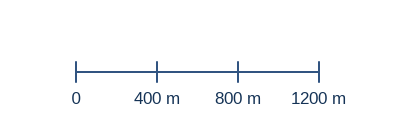
Scale bar with three evenly spaced marks

On the original scale, each one-centimetre step represents 400 metres.

Worked example

Turn a map length into a ground distance

On a map with scale 1:500001:50000, a paved route is 6 cm long. What is its real length in metres?

  1. 6 map centimetres represent 6×500006\times 50000 real centimetres.

  2. Divide 300000 real centimetres by 100 to turn them into metres.

  3. The answer is 30003000.

Your turn

On a map with scale 1:400001:40000, a paved route is 12 cm long. What is its real length in metres?

Enter one number. Fractions and decimals are accepted.

Worked example

Turn a map length into a ground distance

On a map with scale 1:800001:80000, a paved route is 9 cm long. What is its real length in metres?

Try it on paper first.

  1. 9 map centimetres represent 9×800009\times 80000 real centimetres.

  2. Divide 720000 real centimetres by 100 to turn them into metres.

  3. The answer is 72007200.

Your turn

On a map with scale 1:700001:70000, a paved route is 15 cm long. What is its real length in metres?

Enter one number. Fractions and decimals are accepted.

Section 3 of 3 · Core · about 7 min

How do I get back to a length on the map?

Find the ground distance that corresponds to one map centimetre. Count how many such units the full distance contains.

Worked example

Work back from a real distance to a map length

A pathway is 4200 m long. On a plan drawn at 1:600001:60000, how many centimetres long is the pathway?

  1. One map centimetre represents 60000 cm on the ground, or 600 m.

  2. Find how many of those ground-distance units fit in 4200 m.

  3. The answer is 77.

Your turn

A pathway is 6500 m long. On a plan drawn at 1:500001:50000, how many centimetres long is the pathway?

Enter one number. Fractions and decimals are accepted.

Worked example

Work back from a real distance to a map length

A pathway is 2000 m long. On a plan drawn at 1:200001:20000, how many centimetres long is the pathway?

Try it on paper first.

  1. One map centimetre represents 20000 cm on the ground, or 200 m.

  2. Find how many of those ground-distance units fit in 2000 m.

  3. The answer is 1010.

Your turn

A pathway is 12800 m long. On a plan drawn at 1:800001:80000, how many centimetres long is the pathway?

Enter one number. Fractions and decimals are accepted.

Worked examples

Practise the method

Core practice

Question 1 of 5

0 / 5 checked in this collection

Question list

Core practice

Fresh variants

Exam-style

Adapt a recipe to a new serving size

1 mark

A recipe for 8 people uses 1200 g of rice. How much rice is needed for 11 people at the same serving size?

Enter one number. Fractions and decimals are accepted.

Full answer-format guide

Exact numbers: 3/2, sqrt(5), 2-sqrt(3), pi/6, 3*pi/2. Sets: {1,4}. Intervals: (3,5]; a round bracket excludes the endpoint. Infinity: inf; union: U; no solutions: empty. Separate coordinate pairs or triples with semicolons. Expressions: 2x^2+3x-1; equations: x^2=3x+1 or the polynomial equal to zero. Factors: x-1 ; x+2. Parameter fraction: numerator ; denominator. List integer answers individually.

Review the method

Progress stays in this browser. Create an account to save it or sign in.

Extra practice from this lesson

A recipe for 5 people uses 550 g of rice. How much rice is needed for 10 people at the same serving size?

Enter one number. Fractions and decimals are accepted.

A recipe for 6 people uses 690 g of rice. How much rice is needed for 11 people at the same serving size?

Enter one number. Fractions and decimals are accepted.

On a map with scale 1:600001:60000, a paved route is 21 cm long. What is its real length in metres?

Enter one number. Fractions and decimals are accepted.

On a map with scale 1:700001:70000, a paved route is 22 cm long. What is its real length in metres?

Enter one number. Fractions and decimals are accepted.

A pathway is 18400 m long. On a plan drawn at 1:800001:80000, how many centimetres long is the pathway?

Enter one number. Fractions and decimals are accepted.

A pathway is 4800 m long. On a plan drawn at 1:200001:20000, how many centimetres long is the pathway?

Enter one number. Fractions and decimals are accepted.

Apply it · original exam-style problems

Show your working on paper and compare it with the worked solution and marking guidance.

Come back to what needs practice

Quick revision sheet (A4)

Your review plan starts after your first check.