Maths4UBETA

Successive percentage changes (Extended)

Follow changing bases, combine multipliers, report the overall change and work backwards from a final amount.

Try the quick check →
Lesson 5 of 5

Section 1 of 3 · Extension · about 7 min

What does the second percentage apply to?

Apply the first change to the starting value. The result is the starting value for the next stage.

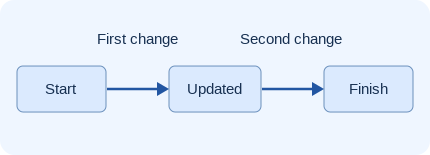
Start, after the first change and finish appear in three separate boxes, linked by arrows.

The second arrow starts at the updated amount.

Worked example

Apply an increase followed by a decrease

The starting volume in a tank is 29002900 litres. It is increased by 8%8\%, then the updated volume decreases by 6%6\%. Find the final volume in litres.

  1. The first multiplier is 1.081.08 and the second is 0.940.94.

  2. The combined multiplier is 1.08×0.94=1.01521.08\times0.94=1.0152.

  3. 2900×1.0152=2944.082900\times1.0152=2944.08.

Your turn

The starting volume in a tank is 400400 litres. It is increased by 12%12\%, then the updated volume decreases by 9%9\%. Find the final volume in litres.

Enter an exact value or round to 3 significant figures.

Worked example

Use two decreases on different bases

A batch starts with mass 54005400 kg. Stage 1 reduces its mass by 20%20\%. Stage 2 reduces the remaining mass by 16%16\%. Find the mass after both drying stages in kilograms.

Try it on paper first.

  1. The first multiplier is 0.80.8 and the second is 0.840.84.

  2. The combined multiplier is 0.8×0.84=0.6720.8\times0.84=0.672.

  3. 5400×0.672=3628.85400\times0.672=3628.8.

Your turn

A batch starts with mass 29002900 kg. Stage 1 reduces its mass by 22%22\%. Stage 2 reduces the remaining mass by 20%20\%. Find the mass after both drying stages in kilograms.

Enter an exact value or round to 3 significant figures.

Section 2 of 3 · Extension · about 8 min

How do I decide the overall percentage change?

The final amount is the initial amount multiplied by the product of the stage multipliers. That product describes the fraction of the original that remains.

Worked example

Calculate the net change after equal rates

The size of an image file first increases by 5%5\%. The resulting size then decreases by 5%5\%. Find the overall percentage decrease from the original size.

  1. The first multiplier is 1.051.05 and the second is 0.950.95.

  2. The combined multiplier is 1.05×0.95=0.99751.05\times0.95=0.9975.

  3. The final value is 99.75%99.75\% of the original, so the overall decrease is 0.25%0.25\%.

Your turn

The size of an image file first increases by 6%6\%. The resulting size then decreases by 6%6\%. Find the overall percentage decrease from the original size. Enter the number before the percent sign.

Give the percentage, for example 25% or 25.

Worked example

Interpret the product of two reductions

A supplier reduces a packaging fee by 11.25%11.25\%. The reduced fee is then cut by a further 28%28\%. Find the overall percentage decrease.

Try it on paper first.

  1. The first multiplier is 0.88750.8875 and the second is 0.720.72.

  2. The combined multiplier is 0.8875×0.72=0.6390.8875\times0.72=0.639.

  3. The final value is 63.9%63.9\% of the original, so the overall decrease is 36.1%36.1\%.

Your turn

A supplier reduces a packaging fee by 13.25%13.25\%. The reduced fee is then cut by a further 30%30\%. Find the overall percentage decrease. Enter the number before the percent sign.

Give the percentage, for example 25% or 25.

Section 3 of 3 · Extension · about 9 min

How do I undo a chain or return to a former amount?

When only the final amount is supplied, recover the original by undoing every stage. When restoring one quantity, the current amount is the denominator of the required percentage increase.

Worked example

Find the increase that restores the original

A vessel's capacity fell from 5750.55750.5 litres to 53005300 litres. By what percentage must the reduced capacity increase to reach the former capacity?

  1. The amount to restore is 5750.5−5300=450.55750.5-5300=450.5 litres.

  2. The requested increase is relative to the reduced capacity; 53005300 goes in the denominator.

  3. 450.55300imes100=8.5\frac{450.5}{5300} imes100=8.5. So the required increase is 8.5%8.5\%.

Your turn

A vessel's capacity fell from 37663766 litres to 28002800 litres. By what percentage must the reduced capacity increase to reach the former capacity? Enter the number before the percent sign.

Give the percentage, for example 25% or 25.

Worked example

Work backwards through two changes

The volume of liquid in a test is increased by 28%28\%, then the updated volume decreases by 26%26\%. The final volume is 7388.167388.16 litres. Find the volume in litres before either change.

Try it on paper first.

  1. The first multiplier is 1.281.28 and the second is 0.740.74.

  2. The combined multiplier is 1.28×0.74=0.94721.28\times0.74=0.9472.

  3. Undo the multiplication: 7388.160.9472=7800\frac{7388.16}{0.9472}=7800 litres.

Your turn

The volume of liquid in a test is increased by 30%30\%, then the updated volume decreases by 28%28\%. The final volume is 4960.84960.8 litres. Find the volume in litres before either change.

Enter one number. Fractions and decimals are accepted.

Worked examples

Practise the method

Core practice

Question 1 of 5

0 / 5 checked in this collection

Question list

Core practice

Fresh variants

Exam-style

Apply an increase followed by a decrease

1 mark

The starting volume in a tank is 64006400 litres. It is increased by 25%25\%, then the updated volume decreases by 23%23\%. Find the final volume in litres.

Enter one number. Fractions and decimals are accepted.

Full answer-format guide

Exact numbers: 3/2, sqrt(5), 2-sqrt(3), pi/6, 3*pi/2. Sets: {1,4}. Intervals: (3,5]; a round bracket excludes the endpoint. Infinity: inf; union: U; no solutions: empty. Separate coordinate pairs or triples with semicolons. Expressions: 2x^2+3x-1; equations: x^2=3x+1 or the polynomial equal to zero. Factors: x-1 ; x+2. Parameter fraction: numerator ; denominator. List integer answers individually.

Review the method

Progress stays in this browser. Create an account to save it or sign in.

Extra practice from this lesson

Apply an increase followed by a decrease

The starting volume in a tank is 72007200 litres. It is increased by 15%15\%, then the updated volume decreases by 12%12\%. Find the final volume in litres.

Enter an exact value or round to 3 significant figures.

Use two decreases on different bases

A batch starts with mass 400400 kg. Stage 1 reduces its mass by 25%25\%. Stage 2 reduces the remaining mass by 23%23\%. Find the mass after both drying stages in kilograms.

Enter one number. Fractions and decimals are accepted.

Calculate the net change after equal rates

The size of an image file first increases by 7%7\%. The resulting size then decreases by 7%7\%. Find the overall percentage decrease from the original size. Enter the number before the percent sign.

Give the percentage, for example 25% or 25.

Interpret the product of two reductions

A supplier reduces a packaging fee by 15.25%15.25\%. The reduced fee is then cut by a further 4%4\%. Find the overall percentage decrease. Enter the number before the percent sign.

Give the percentage, for example 25% or 25.

Find the increase that restores the original

A vessel's capacity fell from 381381 litres to 300300 litres. By what percentage must the reduced capacity increase to reach the former capacity? Enter the number before the percent sign.

Give the percentage, for example 25% or 25.

Work backwards through two changes

The volume of liquid in a test is increased by 32%32\%, then the updated volume decreases by 30%30\%. The final volume is 2587.22587.2 litres. Find the volume in litres before either change.

Enter one number. Fractions and decimals are accepted.

Apply it · original exam-style problems

Show your working on paper and compare it with the worked solution and marking guidance.

Come back to what needs practice

Quick revision sheet (A4)

Your review plan starts after your first check.