Maths4UBETA

Ordering decimals, fractions and measurements

Compare place-value columns, use equal-sized parts and make units match.

Try the quick check →
Lesson 2 of 3

Section 1 of 3 · Core · about 7 min

Which decimal digit decides the order?

Compare from the largest place. Look at the first column where the digits differ.

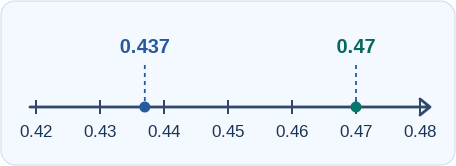
A decimal line marks 0.437 and 0.47 in their correct places.

The point at 0.4370.437 is to the left of 0.470.47.

Worked example

Compare decimals digit by digit

Choose the correct sign for 1.3  □  1.2071.3\;\square\;1.207.

  1. Line up the decimal points. Extend the shorter decimal with zeroes to show the same place-value columns.

  2. Compare 1.3001.300 and 1.2071.207 from the left. The first differing column is the tenths column.

  3. The comparison is 1.3>1.2071.3>1.207.

Your turn

Choose the correct sign for 1.309  □  1.41.309\;\square\;1.4.

Comparison symbol

Worked example

Recognise equal decimals

Choose the correct sign for 1.1000  □  1.101.1000\;\square\;1.10.

Try it on paper first.

  1. The extra digits are zeroes after the last non-zero decimal digit.

  2. These zeroes add zero thousandths and zero ten-thousandths. Both decimals are the same distance from zero.

  3. The comparison is 1.1000=1.101.1000=1.10.

Your turn

Choose the correct sign for 1.17  □  1.17001.17\;\square\;1.1700.

Comparison symbol

Section 2 of 3 · Core · about 7 min

When can I compare the numerators?

A numerator counts pieces. For it to decide which value is larger, each piece must have the same size.

Worked example

Compare fractions using equal-sized parts

Choose the correct sign for 712  □  49\frac{7}{12}\;\square\;\frac{4}{9}.

  1. Make the fraction parts the same size. Use the positive common denominator 36.

  2. 712=2136\frac{7}{12}=\frac{21}{36} and 49=1636\frac{4}{9}=\frac{16}{36}.

  3. Now compare the numerators. The original fractions satisfy 712>49\frac{7}{12}>\frac{4}{9}.

Your turn

Choose the correct sign for 610  □  814\frac{6}{10}\;\square\;\frac{8}{14}.

Comparison symbol

Worked example

Use one half as a benchmark

Which fraction in 614,12,914\frac{6}{14},\quad \frac{1}{2},\quad \frac{9}{14} is greater than 12\frac{1}{2}? Give the fraction.

Try it on paper first.

  1. In 14 equal parts, halfway is 7 parts. The fraction 614\frac{6}{14} is below halfway.

  2. 9 parts is above halfway, so the fraction is 914\frac{9}{14}.

  3. The fraction 12\frac{1}{2} lies exactly at the halfway mark.

Your turn

Which fraction in 1220,920,12\frac{12}{20},\quad \frac{9}{20},\quad \frac{1}{2} is greater than 12\frac{1}{2}? Give the fraction.

Enter an exact value or round to 3 significant figures.

Section 3 of 3 · Core · about 7 min

How do I compare measurements fairly?

Compare like quantities on the same scale. Decide which unit will make the comparison exact and convenient.

Worked example

Compare lengths in the same unit

Choose the correct sign for 3.1 cm  □  35 mm3.1\,\mathrm{cm}\;\square\;35\,\mathrm{mm}.

  1. These are both lengths. Put them in the same unit before comparing.

  2. Each centimetre has 10 millimetres, so 3.1 cm=31 mm3.1\,\mathrm{cm}=31\,\mathrm{mm}.

  3. Compare 31 mm and 35 mm. This gives 3.1 cm<35 mm3.1\,\mathrm{cm}<35\,\mathrm{mm}.

Your turn

Choose the correct sign for 3.4 cm  □  34 mm3.4\,\mathrm{cm}\;\square\;34\,\mathrm{mm}.

Comparison symbol

Worked example

Order close decimals largest first

Write these values in order from largest to smallest: 1.017,1.07,1.0191.017,\quad 1.07,\quad 1.019. Fill all three positions.

Try it on paper first.

  1. With three decimal places the values are 1.017,1.070,1.0191.017,\quad 1.070,\quad 1.019.

  2. Compare each column from left to right. Stop at the first differing digit.

  3. Largest first gives 1.070>1.019>1.0171.070>1.019>1.017.

Your turn

Write these values in order from largest to smallest: 1.47,1.419,1.4171.47,\quad 1.419,\quad 1.417. Fill all three positions.

Enter an exact value or round to 3 significant figures.

Enter an exact value or round to 3 significant figures.

Enter an exact value or round to 3 significant figures.

Worked examples

Practise the method

Core practice

Question 1 of 5

0 / 5 checked in this collection

Question list

Core practice

Fresh variants

Exam-style

Compare decimals digit by digit

1 mark

Choose the correct sign for 1.513  □  1.61.513\;\square\;1.6.

Comparison symbol

Choose one option. Explain your reasoning on paper.

Review the method

Progress stays in this browser. Create an account to save it or sign in.

Extra practice from this lesson

Compare decimals digit by digit

Choose the correct sign for 1.5  □  1.4111.5\;\square\;1.411.

Comparison symbol

Recognise equal decimals

Choose the correct sign for 1.2400  □  1.241.2400\;\square\;1.24.

Comparison symbol

Compare fractions using equal-sized parts

Choose the correct sign for 916  □  711\frac{9}{16}\;\square\;\frac{7}{11}.

Comparison symbol

Use one half as a benchmark

Which fraction in 1226,12,1526\frac{12}{26},\quad \frac{1}{2},\quad \frac{15}{26} is greater than 12\frac{1}{2}? Give the fraction.

Enter an exact value or round to 3 significant figures.

Compare lengths in the same unit

Choose the correct sign for 3.7 cm  □  31 mm3.7\,\mathrm{cm}\;\square\;31\,\mathrm{mm}.

Comparison symbol

Order close decimals largest first

Write these values in order from largest to smallest: 1.817,1.87,1.8191.817,\quad 1.87,\quad 1.819. Fill all three positions.

Enter an exact value or round to 3 significant figures.

Enter an exact value or round to 3 significant figures.

Enter an exact value or round to 3 significant figures.

Apply it · original exam-style problems

Show your working on paper and compare it with the worked solution and marking guidance.

Come back to what needs practice

Quick revision sheet (A4)

Your review plan starts after your first check.