Maths4UBETA

Letters and expressions

Read what a letter stands for and write simple expressions from everyday quantities.

Try the quick check →
Lesson 1 of 3

Section 1 of 3 · Core · about 7 min

What can a letter represent?

A letter can stand for a quantity that changes. If one bag contains n items, another bag with the same contents also has n items.

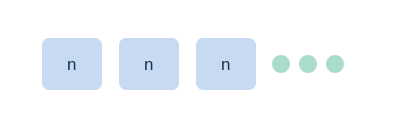
Three equal bags followed by three loose counters.

The three bags each stand for nn counters. The loose counters add three more.

Worked example

Write repeated groups and the extra items

There are 4 bags with nn counters in each bag, plus 5 loose counters. Write an expression for the total.

  1. Multiply the number of bags, 4, by the number of counters in each bag, nn.

  2. The loose counters add 55 to the product.

  3. The expression is 4n+54n+5.

Your turn

There are 2 bags with nn counters in each bag, plus 11 loose counters. Write an expression for the total.

Enter an expression in n; use ^ for powers and / for fractions.

Worked example

Write repeated groups and the extra items

There are 7 bags with nn counters in each bag, plus 8 loose counters. Write an expression for the total.

Try it on paper first.

  1. Multiply the number of bags, 7, by the number of counters in each bag, nn.

  2. The loose counters add 88 to the product.

  3. The expression is 7n+87n+8.

Your turn

There are 5 bags with nn counters in each bag, plus 14 loose counters. Write an expression for the total.

Enter an expression in n; use ^ for powers and / for fractions.

Section 2 of 3 · Core · about 7 min

Where do I start with a difference?

Start from the quantity named after 'less than'. Then take away the stated amount.

Worked example

Write a difference in the stated order

Write an expression for 6 less than a number xx.

  1. Start from the named number. 'Less than' tells you how much to take away.

  2. Subtract 66 from xx.

  3. The expression is x−6x-6.

Your turn

Write an expression for 12 less than a number xx.

Enter an expression in x; use ^ for powers and / for fractions.

Worked example

Write a difference in the stated order

Write an expression for 9 less than a number xx.

Try it on paper first.

  1. Start from the named number. 'Less than' tells you how much to take away.

  2. Subtract 99 from xx.

  3. The expression is x−9x-9.

Your turn

Write an expression for 15 less than a number xx.

Enter an expression in x; use ^ for powers and / for fractions.

Section 3 of 3 · Core · about 7 min

When does a group need brackets?

Work out what belongs to one group first. When there are several copies, the multiplication must apply to the whole group.

Worked example

Use brackets for the full group

A print shop makes 8 packs. Each pack contains aa large cards and 6 small cards. Write an expression for the total number of cards.

  1. One complete pack contains both sizes of card. Add the part that varies to the fixed number.

  2. Multiply one full pack, a+6a+6, by 88. Use brackets to keep the two sizes together.

  3. The expression is 8(a+6)8(a+6).

Your turn

A print shop makes 7 packs. Each pack contains aa large cards and 6 small cards. Write an expression for the total number of cards.

Enter an expression in a; use ^ for powers and / for fractions.

Worked example

Use brackets for the full group

A print shop makes 4 packs. Each pack contains aa large cards and 3 small cards. Write an expression for the total number of cards.

Try it on paper first.

  1. One complete pack contains both sizes of card. Add the part that varies to the fixed number.

  2. Multiply one full pack, a+3a+3, by 44. Use brackets to keep the two sizes together.

  3. The expression is 4(a+3)4(a+3).

Your turn

A print shop makes 10 packs. Each pack contains aa large cards and 3 small cards. Write an expression for the total number of cards.

Enter an expression in a; use ^ for powers and / for fractions.

Worked examples

Practise the method

Core practice

Question 1 of 5

0 / 5 checked in this collection

Question list

Core practice

Fresh variants

Exam-style

Write repeated groups and the extra items

1 mark

There are 2 bags with nn counters in each bag, plus 27 loose counters. Write an expression for the total.

Enter an expression in n; use ^ for powers and / for fractions.

Full answer-format guide

Exact numbers: 3/2, sqrt(5), 2-sqrt(3), pi/6, 3*pi/2. Sets: {1,4}. Intervals: (3,5]; a round bracket excludes the endpoint. Infinity: inf; union: U; no solutions: empty. Separate coordinate pairs or triples with semicolons. Expressions: 2x^2+3x-1; equations: x^2=3x+1 or the polynomial equal to zero. Factors: x-1 ; x+2. Parameter fraction: numerator ; denominator. List integer answers individually.

Review the method

Progress stays in this browser. Create an account to save it or sign in.

Extra practice from this lesson

There are 2 bags with nn counters in each bag, plus 19 loose counters. Write an expression for the total.

Enter an expression in n; use ^ for powers and / for fractions.

There are 3 bags with nn counters in each bag, plus 20 loose counters. Write an expression for the total.

Enter an expression in n; use ^ for powers and / for fractions.

Write an expression for 21 less than a number xx.

Enter an expression in x; use ^ for powers and / for fractions.

Write an expression for 22 less than a number xx.

Enter an expression in x; use ^ for powers and / for fractions.

A print shop makes 10 packs. Each pack contains aa large cards and 4 small cards. Write an expression for the total number of cards.

Enter an expression in a; use ^ for powers and / for fractions.

A print shop makes 4 packs. Each pack contains aa large cards and 5 small cards. Write an expression for the total number of cards.

Enter an expression in a; use ^ for powers and / for fractions.

Apply it · original exam-style problems

Show your working on paper and compare it with the worked solution and marking guidance.

Come back to what needs practice

Quick revision sheet (A4)

Your review plan starts after your first check.