Maths4UBETA

Scale drawings and three-figure bearings

Convert drawing distances both ways, measure clockwise from north and plot routes with ruler and protractor.

Try the quick check →
Lesson 5 of 15

Section 1 of 3 · Core · about 8 min

When do I multiply or divide by the scale?

A scale connects a drawing length with the real length it represents. Write down what one centimetre represents before starting.

Worked example

Convert a scale-drawing length to a real distance

A plan uses 1 cm to represent 3 m. A path measures 2 cm on the plan. Find its real length in metres.

  1. Each of the 2 centimetres stands for 3 metres.

  2. Multiply 2 by 3. The real distance is 6 m6\,\mathrm{m}.

Your turn

A plan uses 1 cm to represent 4 m. A path measures 3 cm on the plan. Find its real length in metres.

Enter one number. Fractions and decimals are accepted.

Worked example

Find the length to draw at the stated scale

Draw a line to represent a 6 m path using 1 cm to represent 3 m. What length should the line be?

Try it on paper first.

  1. Share the 6 m into groups representing one centimetre.

  2. Divide by 3. The length to draw is 2 cm2\,\mathrm{cm}.

Your turn

Draw a line to represent a 12 m path using 1 cm to represent 4 m. What length should the line be?

Enter one number. Fractions and decimals are accepted.

Section 2 of 3 · Core · about 8 min

Where do I start measuring a bearing?

In ‘B from A’, stand at A. Draw a north arrow at A and measure clockwise to the route AB.

North is indicated by an upward arrow at A. A straight route is shown to B.

The bearing starts at north at A and turns clockwise to the route AB.

Worked example

Convert the units in a ratio scale

A model uses the scale 1 : 300. A real length is 6 m. What is its model length in centimetres?

  1. The scale compares the same units. Convert 6 m to 600 cm.

  2. Divide by 300. The model length is 2 cm2\,\mathrm{cm}.

Your turn

A model uses the scale 1 : 400. A real length is 12 m. What is its model length in centimetres?

Enter one number. Fractions and decimals are accepted.

Worked example

Measure a three-figure bearing

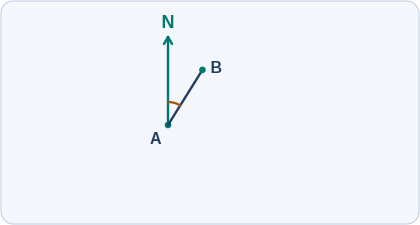
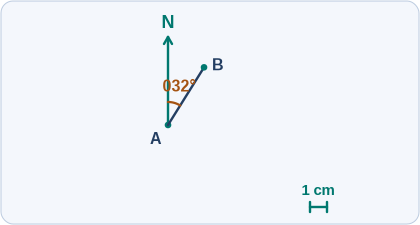
Measure the bearing of B from A. Give a three-figure bearing to the nearest degree.

North is indicated by an upward arrow at A. A straight route is shown to B.

Try it on paper first.

  1. Centre the protractor at A and align zero with the north line.

  2. Measure clockwise from north to the ray AB. The reading is 032∘032^\circ.

Your turn

Measure the bearing of B from A. Give a three-figure bearing to the nearest degree.

North is indicated by an upward arrow at A. A straight route is shown to B.

Round as requested in the label, or enter your calculator value. Decimal or fraction input is accepted.

Section 3 of 3 · Core · about 8 min

How do I draw a route and find its reverse bearing?

First convert the real length to the drawing length. Set the protractor centre at the starting point and mark the clockwise angle.

Worked example

Find a reverse bearing

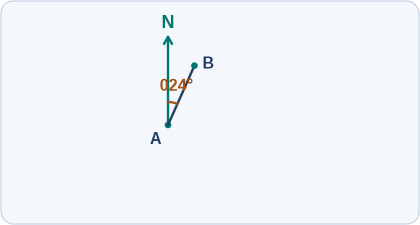
The bearing of B from A is 024∘024^\circ. Find the bearing of A from B.

North is indicated by an upward arrow at A. A straight route is shown to B.

  1. The reverse route points in exactly the opposite direction.

  2. Add a half-turn of 180∘180^\circ. If needed, subtract a full turn. The bearing is 204∘204^\circ.

Your turn

The bearing of B from A is 083∘083^\circ. Find the bearing of A from B.

North is indicated by an upward arrow at A. A straight route is shown to B.

Enter a three-figure bearing, for example 065°.

Worked example

Plot a route using length and bearing

B is 8 km from A on a bearing of 032∘032^\circ. On a 1 cm to 2 km scale, how far from A should B be marked?

  1. 4 cm4\,\mathrm{cm}
  2. 8 cm8\,\mathrm{cm}
  3. 6 cm6\,\mathrm{cm}

Try it on paper first.

  1. Use the given scale to get 4 cm4\,\mathrm{cm}.

  2. Place the protractor at A. Turn clockwise from north through 032∘032^\circ. Measure the drawing length along that ray.

  3. North is indicated by an upward arrow at A. A straight route is shown to B.

Your turn

B is 15 km from A on a bearing of 067∘067^\circ. On a 1 cm to 3 km scale, how far from A should B be marked?

Choose the correct answer

Worked examples

Practise the method

Core practice

Question 1 of 5

0 / 5 checked in this collection

Question list

Core practice

Fresh variants

Exam-style

Convert a scale-drawing length to a real distance

1 mark

A plan uses 1 cm to represent 6 m. A path measures 5 cm on the plan. Find its real length in metres.

Enter one number. Fractions and decimals are accepted.

Full answer-format guide

Exact numbers: 3/2, sqrt(5), 2-sqrt(3), pi/6, 3*pi/2. Sets: {1,4}. Intervals: (3,5]; a round bracket excludes the endpoint. Infinity: inf; union: U; no solutions: empty. Separate coordinate pairs or triples with semicolons. Expressions: 2x^2+3x-1; equations: x^2=3x+1 or the polynomial equal to zero. Factors: x-1 ; x+2. Parameter fraction: numerator ; denominator. List integer answers individually.

Review the method

Progress stays in this browser. Create an account to save it or sign in.

Extra practice from this lesson

Convert a scale-drawing length to a real distance

A plan uses 1 cm to represent 5 m. A path measures 4 cm on the plan. Find its real length in metres.

Enter one number. Fractions and decimals are accepted.

Find the length to draw at the stated scale

Draw a line to represent a 20 m path using 1 cm to represent 5 m. What length should the line be?

Enter one number. Fractions and decimals are accepted.

Convert the units in a ratio scale

A model uses the scale 1 : 500. A real length is 20 m. What is its model length in centimetres?

Enter one number. Fractions and decimals are accepted.

Measure a three-figure bearing

Measure the bearing of B from A. Give a three-figure bearing to the nearest degree.

North is indicated by an upward arrow at A. A straight route is shown to B.

Round as requested in the label, or enter your calculator value. Decimal or fraction input is accepted.

Find a reverse bearing

The bearing of B from A is 154∘154^\circ. Find the bearing of A from B.

North is indicated by an upward arrow at A. A straight route is shown to B.

Enter a three-figure bearing, for example 065°.

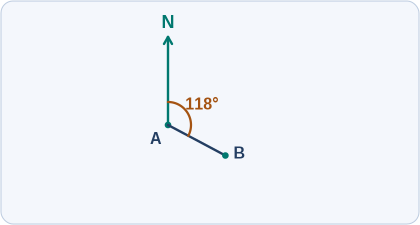
Plot a route using length and bearing

B is 24 km from A on a bearing of 118∘118^\circ. On a 1 cm to 4 km scale, how far from A should B be marked?

Choose the correct answer

Apply it · original exam-style problems

Show your working on paper and compare it with the worked solution and marking guidance.

Come back to what needs practice

Quick revision sheet (A4)

Your review plan starts after your first check.