Maths4UBETA

Restrictions and inverse functions

Choose a branch for a quadratic inverse, read the inverse domain and reverse a reciprocal rule.

Try the quick check →
Lesson 4 of 6

Section 1 of 3 · Extension · about 6 min

Why might a function have no inverse function?

If different inputs share an output, the output alone cannot identify the original input.
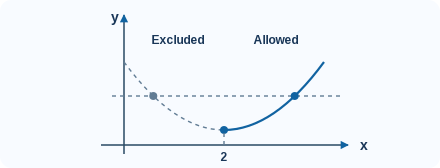
A horizontal line meets a quadratic on two branches. Only the solid branch on and to the right of the vertex is allowed.

y=(x−2)2+1y=(x-2)^2+1. With the left branch removed, each attained output has one original input.

Worked example

Find a second input with the same image

The function q(x)=(x−6)2+3q(x)=\left(x - 6\right)^{2} + 3 is given.

The input 88 maps to 77. Which other input maps to the same output?

  1. 44
  2. 66
  3. 88
  4. 99
  1. The distance from 66 is 22 on each side of the vertex.

  2. q(4)=q(8)=7q(4)=q(8)=7

  3. The unrestricted quadratic has no inverse function.

Your turn

The function q(x)=(x−3)2+6q(x)=\left(x - 3\right)^{2} + 6 is given.

The input 66 maps to 1515. Which other input maps to the same output?

Choose one answer

Worked example

Select the branch allowed by the original domain

The function q(x)=(x−7)2+3q(x)=\left(x - 7\right)^{2} + 3 is given. The domain is x≥7x\ge 7.

Which expression is q−1(x)q^{-1}(x)?

  1. 7−x−37 - \sqrt{x - 3}
  2. x+3+7\sqrt{x + 3} + 7
  3. x−3−7\sqrt{x - 3} - 7
  4. x−3+7\sqrt{x - 3} + 7

Try it on paper first.

  1. y−3=(x−7)2y-3=(x-7)^2

  2. The original input satisfies x≥7x\ge 7. Use the non-negative branch for x−7x-7.

  3. q−1(x)=x−3+7q^{-1}(x)=\sqrt{x - 3} + 7

Your turn

The function q(x)=(x−4)2+6q(x)=\left(x - 4\right)^{2} + 6 is given. The domain is x≥4x\ge 4.

Which expression is q−1(x)q^{-1}(x)?

Choose one answer

Section 2 of 3 · Extension · about 7 min

Which sign belongs in the inverse?

Rearranging a quadratic often gives two algebraic candidates. The original domain tells you which candidate the inverse can return.

Worked example

Select the branch allowed by the original domain

The function q(x)=(x−8)2+3q(x)=\left(x - 8\right)^{2} + 3 is given. The domain is x≤8x\le 8.

Which expression is q−1(x)q^{-1}(x)?

  1. 8−x+38 - \sqrt{x + 3}
  2. −x−3−8- \sqrt{x - 3} - 8
  3. 8−x−38 - \sqrt{x - 3}
  4. x−3+8\sqrt{x - 3} + 8
  1. y−3=(x−8)2y-3=(x-8)^2

  2. The original input satisfies x≤8x\le 8. Use the non-positive branch for x−8x-8.

  3. q−1(x)=8−x−3q^{-1}(x)=8 - \sqrt{x - 3}

Your turn

The function q(x)=(x−5)2+6q(x)=\left(x - 5\right)^{2} + 6 is given. The domain is x≤5x\le 5.

Which expression is q−1(x)q^{-1}(x)?

Choose one answer

Worked example

Evaluate a restricted inverse

The function q(x)=(x−9)2+3q(x)=\left(x - 9\right)^{2} + 3 is given. The domain is x≥9x\ge 9.

Find q−1(28)q^{-1}(28).

Try it on paper first.

  1. (x−9)2=25(x-9)^2=25

  2. x−9=5x-9=5

  3. x=14x=14

Your turn

The function q(x)=(x−6)2+6q(x)=\left(x - 6\right)^{2} + 6 is given. The domain is x≥6x\ge 6.

Find q−1(10)q^{-1}(10).

Enter one number. Fractions and decimals are accepted.

Section 3 of 3 · Extension · about 8 min

What are the allowable inputs of the inverse?

The inverse receives values from the range of the original. Its outputs lie in the original domain.

Worked example

Invert a shifted reciprocal

The function r(x)=4+4x−2r(x)=4 + \frac{4}{x - 2} is given. Take x≠2x\ne 2.

Find r−1(x)r^{-1}(x) as one fraction.

  1. Write y for the original output.

  2. y−4=4x−2y-4=\frac{4}{x-2}

  3. x−2=4y−4x-2=\frac{4}{y-4}

  4. r−1(x)=2x−4x−4r^{-1}(x)=\frac{2 x - 4}{x - 4}

  5. The inverse cannot take x=4x=4.

Your turn

The function r(x)=6+9x−7r(x)=6 + \frac{9}{x - 7} is given. Take x≠7x\ne 7.

Find r−1(x)r^{-1}(x) as one fraction.

Enter a single fraction such as (2x+1)/(x−3). You can also separate the numerator and denominator with a semicolon.

Worked example

Swap the range and domain

The function q(x)=(x−3)2+4q(x)=\left(x - 3\right)^{2} + 4 is given. Its domain is 3≤x≤63\le x\le 6.

State the domain of its inverse in terms of xx.

Try it on paper first.

  1. The original function increases on this restricted interval.

  2. Its range runs from 44 to 1313, including both ends.

  3. Domain of the inverse 4≤x≤134\le x\le 13.

Your turn

The function q(x)=(x−8)2+6q(x)=\left(x - 8\right)^{2} + 6 is given. Its domain is 8≤x≤128\le x\le 12.

State the domain of its inverse in terms of xx.

Use inequalities in x or interval notation. Join intervals with ‘or’ or ∪. Enter an isolated value on its own.

Worked examples

Practise the method

Core practice

Question 1 of 5

0 / 5 checked in this collection

Question list

Core practice

Fresh variants

Exam-style

Find a second input with the same image

1 mark

The function q(x)=(x−6)2+11q(x)=\left(x - 6\right)^{2} + 11 is given.

The input 88 maps to 1515. Which other input maps to the same output?

Choose one answer

Choose one option. Explain your reasoning on paper.

Review the method

Progress stays in this browser. Create an account to save it or sign in.

Extra practice from this lesson

Find a second input with the same image

The function q(x)=(x−9)2+8q(x)=\left(x - 9\right)^{2} + 8 is given.

The input 1414 maps to 3333. Which other input maps to the same output?

Choose one answer

Select the branch allowed by the original domain

The function q(x)=(x−2)2+9q(x)=\left(x - 2\right)^{2} + 9 is given. The domain is x≥2x\ge 2.

Which expression is q−1(x)q^{-1}(x)?

Choose one answer

Select the branch allowed by the original domain

The function q(x)=(x−3)2+9q(x)=\left(x - 3\right)^{2} + 9 is given. The domain is x≤3x\le 3.

Which expression is q−1(x)q^{-1}(x)?

Choose one answer

Evaluate a restricted inverse

The function q(x)=(x−4)2+9q(x)=\left(x - 4\right)^{2} + 9 is given. The domain is x≥4x\ge 4.

Find q−1(25)q^{-1}(25).

Enter one number. Fractions and decimals are accepted.

Invert a shifted reciprocal

The function r(x)=9+14x−5r(x)=9 + \frac{14}{x - 5} is given. Take x≠5x\ne 5.

Find r−1(x)r^{-1}(x) as one fraction.

Enter a single fraction such as (2x+1)/(x−3). You can also separate the numerator and denominator with a semicolon.

Swap the range and domain

The function q(x)=(x−6)2+9q(x)=\left(x - 6\right)^{2} + 9 is given. Its domain is 6≤x≤86\le x\le 8.

State the domain of its inverse in terms of xx.

Use inequalities in x or interval notation. Join intervals with ‘or’ or ∪. Enter an isolated value on its own.

Apply it · original exam-style problems

Show your working on paper and compare it with the worked solution and marking guidance.

Come back to what needs practice

Quick revision sheet (A4)

Your review plan starts after your first check.