Worked example
Read the gradient from a general-form line
Find the gradient of .
Move the x-term to the right, then divide every term by the coefficient of y.
In , the coefficient of x is the gradient.
The answer is .
Rearrange a line equation, identify its gradient and draw it from its intercepts.
Try the quick check →Section 1 of 3 · Core · about 7 min
Move the x-term across the equals sign. Then divide every term by the coefficient of y.
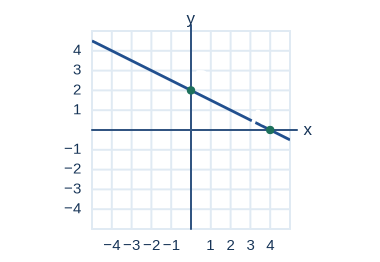
The equation gives the two intercepts shown. Plot both points and extend the line.
Worked example
Find the gradient of .
Move the x-term to the right, then divide every term by the coefficient of y.
In , the coefficient of x is the gradient.
The answer is .
Worked example
Find the gradient of .
Try it on paper first.
Move the x-term to the right, then divide every term by the coefficient of y.
In , the coefficient of x is the gradient.
The answer is .
Section 2 of 3 · Core · about 7 min
At each crossing, one coordinate is zero. Find both intercepts, place them on labelled axes and join them.
Worked example
Find the x-coordinate where crosses the x-axis.
At the x-axis, y is zero. At the y-axis, x is zero.
Substitute zero for y and solve .
At the y-axis the crossing is . Plot both points and draw the line.
The answer is .
Worked example
Find the x-coordinate where crosses the x-axis.
Try it on paper first.
At the x-axis, y is zero. At the y-axis, x is zero.
Substitute zero for y and solve .
At the y-axis the crossing is . Plot both points and draw the line.
The answer is .
Section 3 of 3 · Core · about 7 min
Choose a common multiple of the denominators. Multiply each term by it, then collect the variables on the left.
Worked example
Give an equivalent equation to . You can clear the denominator to write it in general form.
Multiply the entire equation by to remove the denominator.
This gives . Move the x-term to the left and simplify common factors if desired.
The equation is .
Worked example
Give an equivalent equation to . You can clear the denominator to write it in general form.
Try it on paper first.
Multiply the entire equation by to remove the denominator.
This gives . Move the x-term to the left and simplify common factors if desired.
The equation is .
Question 1 of 5
0 / 5 checked in this collection
Find the gradient of .
Progress stays in this browser. Create an account to save it or sign in.
Show your working on paper and compare it with the worked solution and marking guidance.
Your review plan starts after your first check.