Maths4UBETA

Enter calculations accurately

Copy the grouping of a written calculation into a scientific calculator and check the entry before finding its value.

Try the quick check →
Lesson 1 of 4

Section 1 of 3 · Core · about 7 min

How do I keep a numerator and denominator together?

Find the main fraction bar in the question. It divides all of the top expression by all of the bottom expression. Decide which numbers belong on each side before you type.

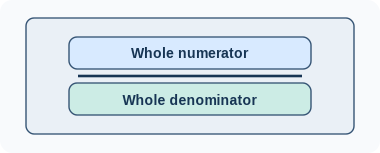
A two-line calculator fraction template. The numerator occupies the whole top line and the denominator occupies the whole lower line.

Keep both whole expressions in the fraction template. The bar separates them.

Try this method

Use a fraction template if your model has one. Enter the top, move to the bottom and enter it. For a one-line entry, put brackets around each whole part and put division between them.

Worked example

Keep both parts of a fraction together

Use your calculator to find 11+69−3\frac{11+6}{9-3}. Give the exact value.

  1. Put 11+611+6 in the numerator and 9−39-3 in the denominator. With a division key, enclose both parts in brackets.

  2. The calculator is dividing 1717 by 66. The exact answer is 176\frac{17}{6}.

Your turn

Use your calculator to find 12+710−4\frac{12+7}{10-4}. Give the exact value.

Enter one number. Fractions and decimals are accepted.

Worked example

Keep both parts of a fraction together

Use your calculator to find 6+312−2\frac{6+3}{12-2}. Give the exact value.

Try it on paper first.

  1. Put 6+36+3 in the numerator and 12−212-2 in the denominator. With a division key, enclose both parts in brackets.

  2. The calculator is dividing 99 by 1010. The exact answer is 910\frac{9}{10}.

Your turn

Use your calculator to find 7+413−3\frac{7+4}{13-3}. Give the exact value.

Enter one number. Fractions and decimals are accepted.

Section 2 of 3 · Core · about 6 min

How far does the root extend?

A written root bar shows which expression the root covers. A calculator may draw a similar bar or put the root expression in brackets on one line.

Try this method

Point to the first and last term under the written bar. Type those terms with their signs inside one root. Read the grouped entry back before evaluating.

Worked example

Check where the square root ends

Use your calculator to work out 81+19\sqrt{81+19}.

  1. Enter 81+1981+19 inside one root template. In a one-line entry use brackets to put both terms inside the root.

  2. The whole quantity under the root is 100100. Its square root is 1010.

Your turn

Use your calculator to work out 100+44\sqrt{100+44}.

Enter one number. Fractions and decimals are accepted.

Worked example

Check where the square root ends

Use your calculator to work out 16+9\sqrt{16+9}.

Try it on paper first.

  1. Enter 16+916+9 inside one root template. In a one-line entry use brackets to put both terms inside the root.

  2. The whole quantity under the root is 2525. Its square root is 55.

Your turn

Use your calculator to work out 25+24\sqrt{25+24}.

Enter one number. Fractions and decimals are accepted.

Section 3 of 3 · Core · about 7 min

When do I need brackets around a negative number?

A negative sign belongs to a number. Subtraction acts between two expressions. Some calculators use two different keys for those jobs.

Try this method

Use the sign key or model equivalent to enter the negative number. Put brackets around the negative base before raising it to a power. Exit the power before typing the next operation.

Worked example

Enter a negative base with brackets

Use your calculator to work out (−6)2+6(-6)^2+6.

  1. Enter the negative sign and 66 within brackets before you press the square key. The base is −6-6.

  2. The square is 3636. Move out of the exponent or close the brackets before adding 66. This gives 4242.

Your turn

Use your calculator to work out (−7)2+7(-7)^2+7.

Enter one number. Fractions and decimals are accepted.

Worked example

Enter a negative base with brackets

Use your calculator to work out (−9)2+2(-9)^2+2.

Try it on paper first.

  1. Enter the negative sign and 99 within brackets before you press the square key. The base is −9-9.

  2. The square is 8181. Move out of the exponent or close the brackets before adding 22. This gives 8383.

Your turn

Use your calculator to work out (−10)2+3(-10)^2+3.

Enter one number. Fractions and decimals are accepted.

Worked examples

Practise the method

Core practice

Question 1 of 5

0 / 5 checked in this collection

Question list

Core practice

Fresh variants

Exam-style

Keep both parts of a fraction together

1 mark

Use your calculator to find 8+77−4\frac{8+7}{7-4}. Give the exact value.

Enter one number. Fractions and decimals are accepted.

Full answer-format guide

Exact numbers: 3/2, sqrt(5), 2-sqrt(3), pi/6, 3*pi/2. Sets: {1,4}. Intervals: (3,5]; a round bracket excludes the endpoint. Infinity: inf; union: U; no solutions: empty. Separate coordinate pairs or triples with semicolons. Expressions: 2x^2+3x-1; equations: x^2=3x+1 or the polynomial equal to zero. Factors: x-1 ; x+2. Parameter fraction: numerator ; denominator. List integer answers individually.

Review the method

Progress stays in this browser. Create an account to save it or sign in.

Extra practice from this lesson

Keep both parts of a fraction together

Use your calculator to find 11+88−3\frac{11+8}{8-3}. Give the exact value.

Enter one number. Fractions and decimals are accepted.

Keep both parts of a fraction together

Use your calculator to find 6+511−2\frac{6+5}{11-2}. Give the exact value.

Enter one number. Fractions and decimals are accepted.

Check where the square root ends

Use your calculator to work out 81+63\sqrt{81+63}.

Enter one number. Fractions and decimals are accepted.

Check where the square root ends

Use your calculator to work out 16+33\sqrt{16+33}.

Enter one number. Fractions and decimals are accepted.

Enter a negative base with brackets

Use your calculator to work out (−5)2+7(-5)^2+7.

Enter one number. Fractions and decimals are accepted.

Enter a negative base with brackets

Use your calculator to work out (−8)2+3(-8)^2+3.

Enter one number. Fractions and decimals are accepted.

Apply it · original exam-style problems

Show your working on paper and compare it with the worked solution and marking guidance.

Come back to what needs practice

Quick revision sheet (A4)

Your review plan starts after your first check.