Maths4UBETA

Simplify rational expressions and keep restrictions

Factorise polynomial numerators and denominators, cancel common factors and state the original restrictions.

Try the quick check →
Lesson 4 of 4

Section 1 of 3 · Core · about 8 min

Which parts can I cancel?

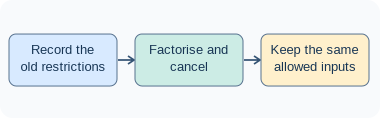
Record the old restrictions. Factorise and cancel. Keep the same allowed inputs.

Cancellation changes the formula but preserves the original restrictions.

Practise the method

If every term contains xx, take it out first. For instance, 3x2+21x=3x(x+7)3x^2+21x=3x(x+7). Then look for the same factor below the bar.

Worked example

Take out a common factor x

Simplify 5x2+30xx2+10x\frac{5 x^{2} + 30 x}{x^{2} + 10 x} fully.

  1. The numerator is 5x(x+6)5 x \left(x + 6\right) and the denominator is x(x+10)x \left(x + 10\right).

  2. Cancel one common factor of xx. Preserve the two exclusions from the original denominator.

  3. The simplified result is 5x+30x+10\frac{5 x + 30}{x + 10}.

  4. The original restrictions remain x≠0,x≠−10x\ne 0,\quad x\ne -10.

Your turn

Simplify 6x2+42xx2+11x\frac{6 x^{2} + 42 x}{x^{2} + 11 x} fully.

Enter a single fraction such as (2x+1)/(x−3). You can also separate the numerator and denominator with a semicolon.

Worked example

Factorise before cancelling a bracket

Simplify x2+4x−96x2+6x−112\frac{x^{2} + 4 x - 96}{x^{2} + 6 x - 112} fully.

Try it on paper first.

  1. Factorise the numerator as (x−8)(x+12)\left(x - 8\right) \left(x + 12\right) and the denominator as (x−8)(x+14)\left(x - 8\right) \left(x + 14\right).

  2. The common factor is x−8x - 8. Cancel it where it is non-zero.

  3. The simplified result is x+12x+14\frac{x + 12}{x + 14}.

  4. The original restrictions remain x≠8,x≠−14x\ne 8,\quad x\ne -14.

Your turn

Simplify x2+4x−117x2+6x−135\frac{x^{2} + 4 x - 117}{x^{2} + 6 x - 135} fully.

Enter a single fraction such as (2x+1)/(x−3). You can also separate the numerator and denominator with a semicolon.

Section 2 of 3 · Core · about 9 min

What if the numerator and denominator are quadratics?

Practise the method

Use A2−B2=(A−B)(A+B)A^2-B^2=(A-B)(A+B). Compare complete brackets from the top and bottom before cancelling one.

Worked example

Use a difference of squares

Simplify x2−64x2+7x−120\frac{x^{2} - 64}{x^{2} + 7 x - 120} fully.

  1. Factorise the numerator as (x−8)(x+8)\left(x - 8\right) \left(x + 8\right) and the denominator as (x−8)(x+15)\left(x - 8\right) \left(x + 15\right).

  2. The common factor is x−8x - 8. Cancel it where it is non-zero.

  3. The simplified result is x+8x+15\frac{x + 8}{x + 15}.

  4. The original restrictions remain x≠8,x≠−15x\ne 8,\quad x\ne -15.

Your turn

Simplify x2−81x2+7x−144\frac{x^{2} - 81}{x^{2} + 7 x - 144} fully.

Enter a single fraction such as (2x+1)/(x−3). You can also separate the numerator and denominator with a semicolon.

Worked example

Factorise before cancelling a bracket

Simplify x2+5x−150x2+7x−170\frac{x^{2} + 5 x - 150}{x^{2} + 7 x - 170} fully.

Try it on paper first.

  1. Factorise the numerator as (x−10)(x+15)\left(x - 10\right) \left(x + 15\right) and the denominator as (x−10)(x+17)\left(x - 10\right) \left(x + 17\right).

  2. The common factor is x−10x - 10. Cancel it where it is non-zero.

  3. The simplified result is x+15x+17\frac{x + 15}{x + 17}.

  4. The original restrictions remain x≠10,x≠−17x\ne 10,\quad x\ne -17.

Your turn

Simplify x2+6x−16x2+8x−20\frac{x^{2} + 6 x - 16}{x^{2} + 8 x - 20} fully.

Enter a single fraction such as (2x+1)/(x−3). You can also separate the numerator and denominator with a semicolon.

Section 3 of 3 · Core · about 10 min

Why do some restrictions survive cancellation?

Practise the method

If a cancelled factor is x−9x-9, the original restriction x≠9x\ne 9 remains even when the new formula has no such factor in its denominator.

Worked example

Preserve the original domain after cancelling

A student rewrites x2+6x−160x2+8x−180\frac{x^{2} + 6 x - 160}{x^{2} + 8 x - 180} as x+16x+18\frac{x + 16}{x + 18}. State the allowed real values of xx for the original expression. Give the restrictions as inequalities or intervals.

  1. Factorise the original denominator. It is (x−10)(x+18)\left(x - 10\right) \left(x + 18\right), so it is zero at −18-18 and 1010.

  2. Keep both exclusions after cancelling. The allowed values meet x≠−18,x≠10x\ne -18,\quad x\ne 10.

Your turn

A student rewrites x2+7x−18x2+9x−22\frac{x^{2} + 7 x - 18}{x^{2} + 9 x - 22} as x+9x+11\frac{x + 9}{x + 11}. State the allowed real values of xx for the original expression. Give the restrictions as inequalities or intervals.

Use inequalities in x or interval notation. Join intervals with ‘or’ or ∪. Enter an isolated value on its own.

Worked example

Use a difference of squares

Simplify x2−9x2+9x−36\frac{x^{2} - 9}{x^{2} + 9 x - 36} fully.

Try it on paper first.

  1. Factorise the numerator as (x−3)(x+3)\left(x - 3\right) \left(x + 3\right) and the denominator as (x−3)(x+12)\left(x - 3\right) \left(x + 12\right).

  2. The common factor is x−3x - 3. Cancel it where it is non-zero.

  3. The simplified result is x+3x+12\frac{x + 3}{x + 12}.

  4. The original restrictions remain x≠3,x≠−12x\ne 3,\quad x\ne -12.

Your turn

Simplify x2−16x2+9x−52\frac{x^{2} - 16}{x^{2} + 9 x - 52} fully.

Enter a single fraction such as (2x+1)/(x−3). You can also separate the numerator and denominator with a semicolon.

Worked examples

Practise the method

Core practice

Question 1 of 5

0 / 5 checked in this collection

Question list

Core practice

Fresh variants

Exam-style

Take out a common factor x

1 mark

Simplify 8x2+72xx2+13x\frac{8 x^{2} + 72 x}{x^{2} + 13 x} fully.

Enter a single fraction such as (2x+1)/(x−3). You can also separate the numerator and denominator with a semicolon.

Full answer-format guide

Exact numbers: 3/2, sqrt(5), 2-sqrt(3), pi/6, 3*pi/2. Sets: {1,4}. Intervals: (3,5]; a round bracket excludes the endpoint. Infinity: inf; union: U; no solutions: empty. Separate coordinate pairs or triples with semicolons. Expressions: 2x^2+3x-1; equations: x^2=3x+1 or the polynomial equal to zero. Factors: x-1 ; x+2. Parameter fraction: numerator ; denominator. List integer answers individually.

Review the method

Progress stays in this browser. Create an account to save it or sign in.

Extra practice from this lesson

Take out a common factor x

Simplify 10x2+20xx2+7x\frac{10 x^{2} + 20 x}{x^{2} + 7 x} fully.

Enter a single fraction such as (2x+1)/(x−3). You can also separate the numerator and denominator with a semicolon.

Factorise before cancelling a bracket

Simplify x2+5x−24x2+7x−30\frac{x^{2} + 5 x - 24}{x^{2} + 7 x - 30} fully.

Enter a single fraction such as (2x+1)/(x−3). You can also separate the numerator and denominator with a semicolon.

Use a difference of squares

Simplify x2−16x2+8x−48\frac{x^{2} - 16}{x^{2} + 8 x - 48} fully.

Enter a single fraction such as (2x+1)/(x−3). You can also separate the numerator and denominator with a semicolon.

Factorise before cancelling a bracket

Simplify x2+6x−55x2+8x−65\frac{x^{2} + 6 x - 55}{x^{2} + 8 x - 65} fully.

Enter a single fraction such as (2x+1)/(x−3). You can also separate the numerator and denominator with a semicolon.

Preserve the original domain after cancelling

A student rewrites x2+7x−78x2+9x−90\frac{x^{2} + 7 x - 78}{x^{2} + 9 x - 90} as x+13x+15\frac{x + 13}{x + 15}. State the allowed real values of xx for the original expression. Give the restrictions as inequalities or intervals.

Use inequalities in x or interval notation. Join intervals with ‘or’ or ∪. Enter an isolated value on its own.

Use a difference of squares

Simplify x2−49x2+9x−112\frac{x^{2} - 49}{x^{2} + 9 x - 112} fully.

Enter a single fraction such as (2x+1)/(x−3). You can also separate the numerator and denominator with a semicolon.

Apply it · original exam-style problems

Show your working on paper and compare it with the worked solution and marking guidance.

Come back to what needs practice

Quick revision sheet (A4)

Your review plan starts after your first check.