Maths4U · Learning together
Discrete variables, tables and unknown probabilities
Notes
Objective
Build a valid table and recover unknown probabilities from total probability and moments.
Before you start
Use exact fractions, mutually exclusive outcomes and conditional probabilities. Selection models also use combinations from the preceding chapter. This chapter covers finite discrete distributions; named binomial and geometric models follow in the next chapter.
Key ideas
A variable attaches a number to an outcome
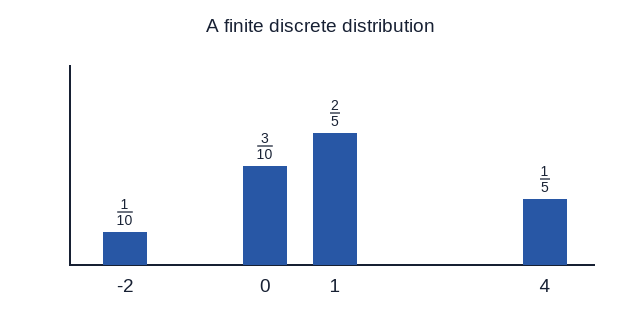
A random variable X records a numerical result of a chance experiment. Its possible values form its support. Capital X denotes the variable; lower-case x denotes a value it can take. A finite distribution lists every possible value once and assigns its total probability.
Check the table before using it
The probabilities, not the values of X, sum to one. A parameter obtained from an equation is acceptable only if every table entry remains non-negative. Negative values of X are allowed; negative probabilities are not.
Expectation is a weighted long-run average
Multiply each value by its probability and add. The mean need not itself be a possible outcome, and it need not be the most probable value. Over n comparable repetitions, the expected frequency of a value is np(x); it is not a guarantee about a particular run.
Variance uses the second moment
Square the value before weighting it. Do not square the probability. Variance is non-negative and has squared units; the standard deviation is its non-negative square root. Keep fractions exact until a requested final rounding.
Unknown entries require independent equations
Normalisation supplies one equation. A stated mean or second moment can supply another. Solve, reconstruct the full table, then test every entry and the stated moment. If variance is supplied, first recover the second moment by adding the square of the mean.
Method
- Define the numerical random variable and list its possible values.
- Choose elementary outcomes and justify their probabilities.
- Combine every route giving the same value; check non-negative probabilities summing to one.
- Find the weighted first and second moments, then subtract the square of the mean.
- For a condition, restrict and renormalise the table before recalculating its moments.
- Interpret the result in its units and check any parameter against the original model.
Common mistakes
- The mean is not the unweighted average of the listed values.
- E(X squared) differs from the square of E(X).
- Do not square probabilities when finding the second moment.
- A normalised table can still be invalid if one entry is negative.
Worked examples
Weights must be normalised
X has the following distribution, with positive k.
Find k, , , and .
Follow the solutionSum the probability coefficients, then divide one by that sum. Form the weighted moments. For the final probability, compare each possible value with the exact mean and add only the entries above it.
Complete answers
Normalising constant k: .
Expected value: .
Variance: .
Probability above the mean: .
Recover two unknown probabilities
X has mean and this distribution.
Find p, q, and .
Follow the solutionUse normalisation and the stated moment as separate equations. Solve simultaneously and check that both probabilities lie between zero and one. Use squared values in a second-moment equation.
Complete answers
Probability p: .
Probability q: .
Expected value: .
Variance: .
A second moment is not a mean
X has second moment and this distribution.
Find p, q, and .
Follow the solutionUse normalisation and the stated moment as separate equations. Solve simultaneously and check that both probabilities lie between zero and one. Use squared values in a second-moment equation.
Complete answers
Probability p: .
Probability q: .
Expected value: .
Variance: .
Normalisation and a mean determine a parameter
X takes values −1, 0, 2 with probabilities t, 1−3t, 2t respectively. Its mean is . Find t, , , , then choose the correct variance rule.
Follow the solutionThe mean equation is . Check , then reconstruct the table. Variance subtracts the square of the mean, not the mean itself.
Complete answers
Parameter t: .
Probability of zero: .
Second moment: .
Variance: .
Correct conclusion: Subtract the square of the mean from the second moment.