Maths4U · Learning together
Weighted means and combined moments
Notes
Objective
Combine at most two data sets through compatible totals, keeping within-group and between-group spread distinct.
Before you start
Order data, read a frequency table and retain exact fractions. Mixed-topic written tasks also use descriptive variance and SD, introduced in the first lesson.
Key ideas
Weight group means by their counts
The unweighted average works only for equal group sizes or coincident means. For positive group sizes and distinct means, the combined mean lies strictly between them.
Combine square-sums, not SDs
Different group centres add between-group spread. Averaging the SDs misses it. Pooling two observed groups is not the same operation as adding two independent random variables.
A target mean can determine a group size
Keep the unknown size in the total count and the weighted sum. Verify that it is a positive integer and that the target mean is feasible.
Put both groups on a common scale first
Decode different origins or units separately, then combine original totals. Adding two differently coded sums as though they measured the same thing is invalid.
Method
- Identify the observation count, measurement units and requested measure.
- Keep exact totals and distinguish raw values from grouped estimates.
- Restore every original count, coding or value condition.
- State the complete result and justify a contextual choice separately.
Common mistakes
- Do not average unequal-size group means without weights.
- Never average SDs to obtain a pooled SD.
- Between-group differences can increase pooled spread.
- Decode both groups to compatible original units before pooling.
Worked examples
Unequal groups pull the combined mean unequally
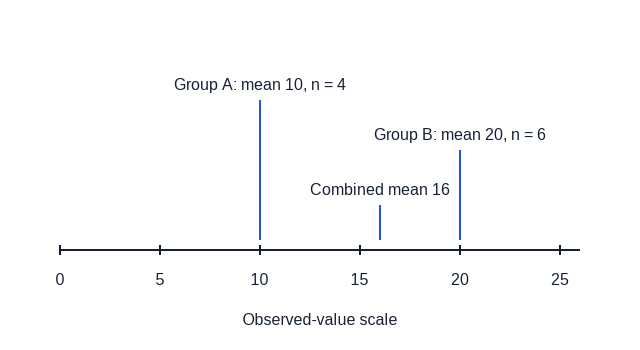
Four observations have mean 10 and six have mean 20. Find the combined mean.
Follow the solutionThe answer is closer to 20 because the second group is larger.
Reconstruct both moments before pooling
A group of 3 has mean 8 and population SD 2; a group of 2 has mean 13 and population SD 3. Find the combined mean and variance.
Follow the solutionBoth the within-group spread and the difference of the two centres contribute.
Recover an unknown count from a target mean
Six values have mean 12. An additional group has mean 18. The combined mean is 16. How many values are in the additional group?
Follow the solutionThe count is a positive integer and the target lies between 12 and 18.
Different coding origins need separate decoding
Group A has 4 values with ; B has 6 values with . Both measure the same quantity. Find the combined mean.
Follow the solutionThe sum of the two coded totals, −4, would not be an original measurement total.