Maths4U · Learning together
Unknown constants, exponents and complete cases
Notes
Objective
Recover constants or a positive integer exponent from coefficient conditions without losing zero cases or pairing signs incorrectly.
Before you start
Recall quadratic equations, complete root sets, ratios and restrictions on denominators or integer exponents.
Key ideas
Write the coefficient before solving
In (a+bx)ⁿ the coefficient of xʳ is . If one symbol is unknown, treat the others according to the stated conditions. Equality of two coefficients does not mean equality of two binomial coefficients alone.
Even powers leave paired branches
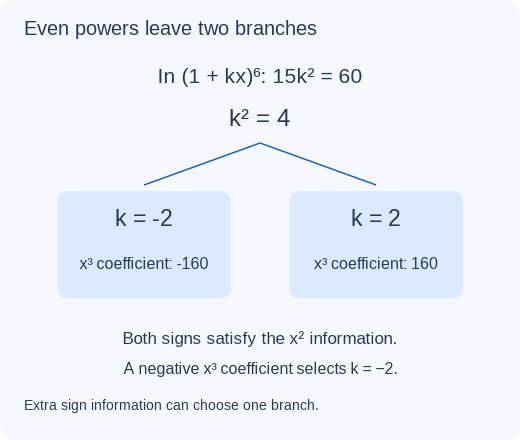
A condition involving k² can give both positive and negative k. A later coefficient involving k³ changes sign with the same choice; keep the correspondence.
An unknown exponent is a positive integer here
A coefficient equation can have a negative algebraic root for n. Check n∈{1,2,3,…}, and n≥r when a nonzero xʳ coefficient is required. This lesson does not use the infinite binomial expansion for non-integer powers.
Record restrictions before dividing
A zero parameter may be allowed in (1+kx)ⁿ, but not in a factor containing 1/k. If a coefficient condition has a factor k, handle k=0 before cancellation. For coupled parameters, solve both original equations and check positivity or nonzero requirements.
Method
- Derive each required coefficient symbolically.
- Write every original parameter and integer restriction.
- Solve all algebraic cases without dividing away a possible zero.
- Reconstruct the original coefficients and retain matched parameter values.
Common mistakes
- An even-power equation can give two signs.
- Keep coefficient values paired with the parameter that produces them.
- A negative root for n is outside this finite-binomial task.
- Do not cancel a parameter until its zero case has been checked.
Worked examples
Both signs and both corresponding coefficients
The x² coefficient of (1+kx)⁶ is 60. Find all k and the matching x³ coefficients.
Follow the solutionThe matched pairs (k,[x³]) are (−2,−160) and (2,160). There is no positivity condition that would remove the negative branch.
A positive integer exponent
In , the x² coefficient is 7. Find the positive integer n and the coefficient of x.
Follow the solutionThe algebraic roots are 8 and −7. Only n=8 is permitted. The coefficient of x is −n/2=−4, providing a second check.
Zero is an admissible parameter unless excluded
In (1+kx)⁴ the x² coefficient is three times the coefficient of x. Find all real k, then state what remains if k is additionally required to be nonzero.
Follow the solutionThus k=0 or 2. Both satisfy the original coefficient equality. Under the extra nonzero requirement only k=2 remains.
A coupled condition fixes two constants
In (a+bx)⁴, a and b are positive, the constant term is 81 and the x and x² coefficients are equal. Find a and b.
Follow the solutionThe constant term gives a⁴=81, so a=3. The equality gives
Division is justified by a,b>0. Hence b=2. Both coefficients are then 216.