Maths4UBETA

Test a claim with evidence

Use totals, ordered outcomes and scale factors to justify conclusions across topics.

Try the quick check →

Section 1 of 3 · Core · about 10 min

Whose visits count in the mean?

A group mean tells you the total per person if everyone shared it equally. Multiply by the headcount to recover the total. The same idea works backwards when the combined mean is known and one group mean is missing.

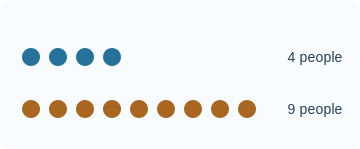
One group of four people and another group of nine.

A person in either group counts once. Use the group sizes to combine group means.

Worked example

Combining two groups fairly

The table gives the numbers of library visits made by the members of two clubs.

ClubMembersMean visits
North83
South1113
  1. Find the mean number of visits per person for both clubs combined. Give an exact answer.

    [2]
  2. Find the total number of visits by members of the larger club.

    [2]
  3. One member changes clubs but keeps the same number of visits. Explain what happens to the combined mean.

    [2]
  1. (a) Find the two totals. The North total is 8 times 3. The South total is 11 times 13.

  2. Together there are 167 visits and 19 people. Divide visits by people.

  3. 16719\frac{167}{19}

  4. (b) Each member contributes 13 visits on average. Multiply by 11 members.

  5. 143143

  6. (c) The move changes the groups. The inputs to the combined mean stay fixed.

  7. It stays the same. The total number of visits and the total number of people are unchanged.
Your turn

The table gives the numbers of library visits made by the members of two clubs.

ClubMembersMean visits
North87
South1313

Find the mean number of visits per person for both clubs combined. Give an exact answer.

Enter one number. Fractions and decimals are accepted.

Worked example

Find a missing group mean

A survey includes 5 senior volunteers and 15 junior volunteers. The 20 volunteers average 7 library visits each. The seniors average 4 visits. Find the junior volunteers’ mean.

Try it on paper first.

  1. The whole survey accounts for 20×7=14020\times7=140 visits. The seniors contribute 5×4=205\times4=20 visits.

  2. The 15 juniors contribute 140−20=120140-20=120 visits.

  3. Divide by the junior headcount to get 120÷15=8120\div15=8 visits per junior on average.

Your turn

Six pupils in one group average 2 trips to the library. There are 10 pupils in the other group. Together the 16 pupils average 7 trips. What is the mean for the group of 10?

Enter one number. Fractions and decimals are accepted.

Your turn

The table gives the numbers of library visits made by the members of two clubs.

ClubMembersMean visits
North97
South1413

Find the mean number of visits per person for both clubs combined. Give an exact answer.

Enter one number. Fractions and decimals are accepted.

Section 2 of 3 · Core · about 10 min

Which outcomes belong to the event?

Decide whether the event names one route or several routes. If the event is ‘at least one’, its complement often gives a single route. Draw or list enough outcomes to see which calculation is shorter.

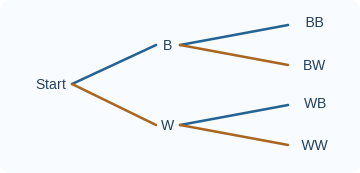
The two possible colours on each of two draws give BB, BW, WB and WW.

BW and WB have different orders. Add their probabilities to count one of each colour.

Worked example

Two draws without replacement

A bag holds 4 blue counters and 5 white counters. Two counters are drawn one after the other. The first counter is kept out of the bag.

  1. Find the probability of getting one counter of each colour, in either order.

    [2]
  2. Find the probability of two blue counters.

    [2]
  3. Explain why the probability of blue usually changes between the first and second draws.

    [2]
  1. (a) List the orders BW and WB. The first draw is from 9 counters. The second draw is from 8 counters.

  2. Each order has probability 518\frac{5}{18}. Add the two probabilities.

  3. 59\frac{5}{9}

  4. (b) After drawing one blue counter, there are 3 blue counters left out of 8.

  5. 16\frac{1}{6}

  6. (c) The first draw determines which counts are used in the fraction for the second draw.

  7. One counter has been removed. If it was blue, both the number of blue counters and the total fall. If it was white, only the total falls.

Your turn

A bag holds 3 blue counters and 8 white counters. Two counters are drawn one after the other. The first counter is kept out of the bag.

Find the probability of getting one counter of each colour, in either order.

Use a fraction, a percentage or a decimal rounded to at least 3 significant figures.

Worked example

Use the complement for at least one blue counter

A bag contains 5 blue and 3 white counters. Two counters are drawn without replacement. Find the probability that at least one counter is blue.

Try it on paper first.

  1. The event fails only if both counters are white. That is one route, so use its probability first.

  2. For two whites the branch probabilities are 38\frac38 and 27\frac27. Their product is 328\frac{3}{28}.

  3. The probability of at least one blue is 1−328=25281-\frac{3}{28}=\frac{25}{28}. This includes two blues.

Your turn

A bag contains four blue and four white counters. Two counters are drawn without replacement. What is the probability of getting at least one white?

Use a fraction, a percentage or a decimal rounded to at least 3 significant figures.

Your turn

A bag holds 4 blue counters and 8 white counters. Two counters are drawn one after the other. The first counter is kept out of the bag.

Find the probability of getting one counter of each colour, in either order.

Use a fraction, a percentage or a decimal rounded to at least 3 significant figures.

Section 3 of 3 · Core · about 10 min

Which measurements scale twice?

A length factor acts on each side separately. When the problem gives only areas, divide the new area by the old area and take the positive square root to recover the length factor.

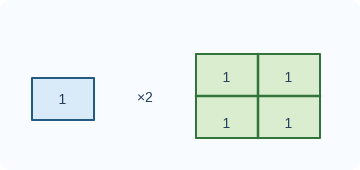
A rectangle is doubled in both directions and contains four copies of the original area.

Doubling both lengths gives four original areas.

Worked example

A larger copy of a display

A rectangular design is 12 cm by 16 cm. A larger copy is made with length scale factor 33.

  1. Find the area of the larger design in square centimetres.

    [2]
  2. Find the perimeter of the larger design in centimetres.

    [2]
  3. Explain why the same multiplier cannot be used for both perimeter and area.

    [2]
  1. (a) Both side lengths are multiplied by 33. The area is multiplied by 99.

  2. The old area is 192 square centimetres. Multiply it by the area factor.

  3. 17281728 square centimetres

  4. (b) The perimeter is a length. Multiply the original perimeter 56 cm by 33 once.

  5. 168168 cm

  6. (c) Writing each calculation using the two side lengths shows how often the scale factor appears.

  7. The perimeter adds scaled lengths. The area multiplies two scaled lengths, so the factor occurs twice.

Your turn

A rectangular design is 12 cm by 18 cm. A larger copy is made with length scale factor 44.

Find the area of the larger design in square centimetres.

Enter one number. Fractions and decimals are accepted.

Worked example

Recover a length scale factor from two areas

A rectangular poster has area 40 square centimetres. A similar poster has area 90 square centimetres. A 10 cm side of the smaller poster corresponds to a side of the larger poster. Find the larger side.

Try it on paper first.

  1. The area factor is 9040=94\frac{90}{40}=\frac94. It is the square of the length scale factor.

  2. The positive length scale factor is 94=32\sqrt{\frac94}=\frac32.

  3. The corresponding length is 10×32=1510\times\frac32=15 cm.

Your turn

A rectangular badge has area 24 square centimetres. A similar badge has area 54 square centimetres. An 8 cm side of the smaller badge corresponds to which length on the larger badge?

Enter one number. Fractions and decimals are accepted.

Your turn

A rectangular design is 3 cm by 10 cm. A larger copy is made with length scale factor 44.

Find the area of the larger design in square centimetres.

Enter one number. Fractions and decimals are accepted.

Worked examples

Practise the method

Core practice

Question 1 of 12

0 / 12 checked in this collection

Question list

Core practice

Fresh variants

Exam-style

Combining two groups fairly

1 mark

The table gives the numbers of library visits made by the members of two clubs.

ClubMembersMean visits
North57
South1915

Find the mean number of visits per person for both clubs combined. Give an exact answer.

Enter one number. Fractions and decimals are accepted.

Full answer-format guide

Exact numbers: 3/2, sqrt(5), 2-sqrt(3), pi/6, 3*pi/2. Sets: {1,4}. Intervals: (3,5]; a round bracket excludes the endpoint. Infinity: inf; union: U; no solutions: empty. Separate coordinate pairs or triples with semicolons. Expressions: 2x^2+3x-1; equations: x^2=3x+1 or the polynomial equal to zero. Factors: x-1 ; x+2. Parameter fraction: numerator ; denominator. List integer answers individually.

Review the method

Progress stays in this browser. Create an account to save it or sign in.

Extra practice from this lesson

The table gives the numbers of library visits made by the members of two clubs.

ClubMembersMean visits
North83
South1514

Find the mean number of visits per person for both clubs combined. Give an exact answer.

Enter one number. Fractions and decimals are accepted.

The table gives the numbers of library visits made by the members of two clubs.

ClubMembersMean visits
North93
South1614

Find the mean number of visits per person for both clubs combined. Give an exact answer.

Enter one number. Fractions and decimals are accepted.

A bag holds 2 blue counters and 11 white counters. Two counters are drawn one after the other. The first counter is kept out of the bag.

Find the probability of getting one counter of each colour, in either order.

Use a fraction, a percentage or a decimal rounded to at least 3 significant figures.

A bag holds 3 blue counters and 11 white counters. Two counters are drawn one after the other. The first counter is kept out of the bag.

Find the probability of getting one counter of each colour, in either order.

Use a fraction, a percentage or a decimal rounded to at least 3 significant figures.

A rectangular design is 12 cm by 20 cm. A larger copy is made with length scale factor 55.

Find the area of the larger design in square centimetres.

Enter one number. Fractions and decimals are accepted.

A rectangular design is 3 cm by 12 cm. A larger copy is made with length scale factor 55.

Find the area of the larger design in square centimetres.

Enter one number. Fractions and decimals are accepted.

Apply it · original exam-style problems

Show your working on paper and compare it with the worked solution and marking guidance.

Come back to what needs practice

Quick revision sheet (A4)

Your review plan starts after your first check.