Maths4UBETA

Show how you know

Use a number line, a bar and pairs of counters to explain a short calculation.

Try the quick check →

Section 1 of 3 · Core · about 10 min

Where did you finish?

Write the floor numbers in order, with 0 for the entrance. Each lift instruction tells you where to start the next move. To work backwards, undo the most recent move first.

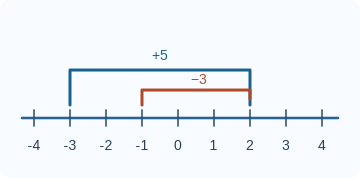
A number line showing a move from −3 to 2 and then to −1.

The route has length 8. It finishes 2 levels above the start.

Worked example

A route between floors

A lift starts on level -5. It goes up 7 levels and then down 3 levels. Level 0 is the entrance.

  1. Which level does the lift reach?

    [2]
  2. How many levels does the lift travel in total?

    [2]
  3. Describe one move that returns the lift to its starting level.

    [2]
  1. (a) A move up adds 7. After that move the lift is on level 2.

  2. A move down subtracts 3. 2−3=−12-3=-1

  3. −1-1

  4. (b) Both moves add to the distance travelled. Add the lengths 7 and 3.

  5. 1010

  6. (c) Compare the finishing level -1 with the starting level -5.

  7. Go down 4 levels.

Your turn

A lift starts on level -9. It goes up 9 levels and then down 4 levels. Level 0 is the entrance.

Which level does the lift reach?

Enter one number. Fractions and decimals are accepted.

Worked example

Work backwards from the final floor

A lift goes up 7 floors, then down 3 floors. It ends on floor 2. On which floor did it start? How many floors did it travel?

Try it on paper first.

  1. Undo the last move by going up 3 from floor 2. That puts the lift on floor 2+3=52+3=5 before the descent.

  2. Undo the first move by going down 7 from floor 5. It started on floor 5−7=−25-7=-2.

  3. For distance travelled, count both moves as lengths. The lift travelled 7+3=107+3=10 floors.

Your turn

A lift goes up 5 floors and then down 2 floors. It finishes on floor 1. On which floor did it start?

Enter one number. Fractions and decimals are accepted.

Your turn

A lift starts on level -2. It goes up 10 levels and then down 4 levels. Level 0 is the entrance.

Which level does the lift reach?

Enter one number. Fractions and decimals are accepted.

Section 2 of 3 · Core · about 10 min

Which parts make the whole?

A batch has a fixed mix. To work from just one colour, divide its count by that colour’s count per batch. This gives the number of whole batches you need for every colour.

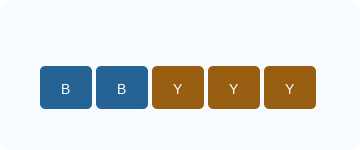
A strip with two blue and three yellow blocks of equal size.

Count all five equal parts before finding the fraction that is blue.

Worked example

Two colours, one batch

Each batch for a school event has 2 blue bands and 3 yellow bands. The organisers pack 20 bands using whole batches.

  1. How many bands are blue?

    [2]
  2. What fraction of the whole batch is blue? Give your answer in simplest form.

    [2]
  3. A volunteer packs 15 yellow bands. How many blue bands should go with them?

    [2]
  1. (a) Each batch has 5 bands. There are 20÷5=420\div 5=4 batches.

  2. There are 2 blue bands in each batch. Multiply by 4.

  3. 88

  4. (b) Use 2 blue bands over 5 bands altogether, then simplify.

  5. 25\frac{2}{5}

  6. (c) Divide the yellow count by 3 to find the new number of batches. Each batch needs 2 blue bands.

  7. 1010

Your turn

Each batch for a school event has 2 blue bands and 4 yellow bands. The organisers pack 36 bands using whole batches.

How many bands are blue?

Enter the whole-number count.

Worked example

Find the total from one colour

Each bracelet uses 3 red beads and 2 green beads. All 12 green beads are used in whole bracelets. Find the total number of beads used and the fraction that are red.

Try it on paper first.

  1. Two green beads go into each bracelet, so 12÷2=612\div2=6 bracelets can be made.

  2. One bracelet uses 3+2=53+2=5 beads. Six bracelets use 6×5=306\times5=30 beads.

  3. Three of the five beads in every bracelet are red. The fraction stays 35\frac35 when all counts are multiplied by 6.

Your turn

Each packet has 7 purple stickers and 3 white stickers. The packets use 15 white stickers altogether. How many stickers are in all the packets?

Enter the whole-number count.

Your turn

Each batch for a school event has 3 blue bands and 5 yellow bands. The organisers pack 48 bands using whole batches.

How many bands are blue?

Enter the whole-number count.

Section 3 of 3 · Core · about 10 min

Will there always be a spare?

An even count can be grouped into pairs with no spare. One extra object changes whether there is a spare. Two extra objects form a new pair, so they leave the spare count the same.

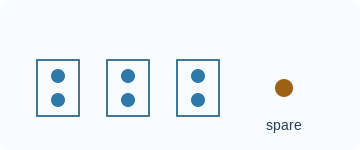
Three pairs of blue counters and one unpaired amber counter.

Making another pair leaves the single counter unpaired.

Worked example

Pairs and spares

A display has 11 pairs of books and 3 single books on a shelf.

  1. How many books are in the display?

    [2]
  2. The number of pairs changes but the number of singles stays the same. Explain why the total is always odd.

    [2]
  3. Another display of this kind has 37 items. How many pairs are there?

    [2]
  1. (a) There are two in each pair. Multiply 11 by 2, then add the 3 singles.

  2. 2525

  3. (b) Group all the items into twos. The singles also leave one unmatched object when put into twos.

  4. Pairs make an even total. The fixed number of singles is odd, so the total is odd.

  5. (c) Remove the 3 singles, then divide the rest by 2.

  6. 1717

Your turn

A display has 8 pairs of books and 5 single books on a shelf.

How many books are in the display?

Enter the whole-number count.

Worked example

Test which change removes a spare

Twenty-three cards are grouped into pairs. Sam adds 4 cards and says there will be no spare. Test the claim. What is the smallest number of extra cards Sam could add to make complete pairs?

Try it on paper first.

  1. Twenty-three cards make 11 pairs and one spare. The four new cards add two complete pairs.

  2. There are now 23+4=2723+4=27 cards. Thirteen pairs use 26 cards, so one is still spare.

  3. Add 1 more card to pair with the spare. Then 2828 cards make 14 pairs.

Your turn

A tray has 6 pairs of badges and 3 single badges. At least one more badge must be added. What is the smallest number to add so that every badge can be paired?

Enter the whole-number count.

Your turn

A display has 9 pairs of books and 5 single books on a shelf.

How many books are in the display?

Enter the whole-number count.

Worked examples

Practise the method

Core practice

Question 1 of 12

0 / 12 checked in this collection

Question list

Core practice

Fresh variants

Exam-style

A route between floors

1 mark

A lift starts on level -6. It goes up 13 levels and then down 5 levels. Level 0 is the entrance.

Which level does the lift reach?

Enter one number. Fractions and decimals are accepted.

Full answer-format guide

Exact numbers: 3/2, sqrt(5), 2-sqrt(3), pi/6, 3*pi/2. Sets: {1,4}. Intervals: (3,5]; a round bracket excludes the endpoint. Infinity: inf; union: U; no solutions: empty. Separate coordinate pairs or triples with semicolons. Expressions: 2x^2+3x-1; equations: x^2=3x+1 or the polynomial equal to zero. Factors: x-1 ; x+2. Parameter fraction: numerator ; denominator. List integer answers individually.

Review the method

Progress stays in this browser. Create an account to save it or sign in.

Extra practice from this lesson

A lift starts on level -5. It goes up 12 levels and then down 6 levels. Level 0 is the entrance.

Which level does the lift reach?

Enter one number. Fractions and decimals are accepted.

A lift starts on level -6. It goes up 12 levels and then down 6 levels. Level 0 is the entrance.

Which level does the lift reach?

Enter one number. Fractions and decimals are accepted.

Each batch for a school event has 2 blue bands and 5 yellow bands. The organisers pack 49 bands using whole batches.

How many bands are blue?

Enter the whole-number count.

Each batch for a school event has 3 blue bands and 6 yellow bands. The organisers pack 63 bands using whole batches.

How many bands are blue?

Enter the whole-number count.

A display has 5 pairs of books and 7 single books on a shelf.

How many books are in the display?

Enter the whole-number count.

A display has 6 pairs of books and 7 single books on a shelf.

How many books are in the display?

Enter the whole-number count.

Apply it · original exam-style problems

Show your working on paper and compare it with the worked solution and marking guidance.

Come back to what needs practice

Quick revision sheet (A4)

Your review plan starts after your first check.