← Back to the lesson

Cambridge IGCSE Additional Mathematics (0606) · Calculus: Differentiation 1 · Quick revision

Quotient rule and restrictions

Which product comes first?

For y=uvy=\frac{u}{v}, with v≠0v\ne0, y′=vu′−uv′v2y'=\frac{vu'-uv'}{v^2}.

Where is a quotient defined?

The original quotient requires v(x)≠0v(x)\ne0. Any equivalent expression and its derivative inherit that restriction.

How can a bracketed numerator stay readable?

Use the chain rule to obtain u′u' before substituting it into vu′−uv′v2\frac{vu'-uv'}{v^2}.

Quick worked example

A curve has equation y=x2+1x+3y=\frac{x^{2} + 1}{x + 3}.

Find dydx\frac{\mathrm dy}{\mathrm dx}.

  1. dydx=−7+−x2+2x(x+3)−1(x+3)2\frac{\mathrm dy}{\mathrm dx}=-7 + \frac{- x^{2} + 2 x \left(x + 3\right) - 1}{\left(x + 3\right)^{2}}
  2. dydx=9+−x2+2x(x+3)−1(x+3)2\frac{\mathrm dy}{\mathrm dx}=9 + \frac{- x^{2} + 2 x \left(x + 3\right) - 1}{\left(x + 3\right)^{2}}
  3. dydx=−x2+2x(x+3)−1(x+3)2\frac{\mathrm dy}{\mathrm dx}=\frac{- x^{2} + 2 x \left(x + 3\right) - 1}{\left(x + 3\right)^{2}}
  4. dydx=−−x2+2x(x+3)−1(x+3)2\frac{\mathrm dy}{\mathrm dx}=- \frac{- x^{2} + 2 x \left(x + 3\right) - 1}{\left(x + 3\right)^{2}}

Here u=x2+1, v=x+3, u′=2x, v′=1u=x^2+1,\ v=x+3,\ u^\prime=2x,\ v^\prime=1. The original domain excludes x=−3x=-3.

Use (x+3)(2x)−(x2+1)(x+3)2\frac{(x+3)(2x)-(x^2+1)}{(x+3)^2}. Simplifying gives x2+6x−1(x+3)2\frac{x^2+6x-1}{(x+3)^2}, option C.

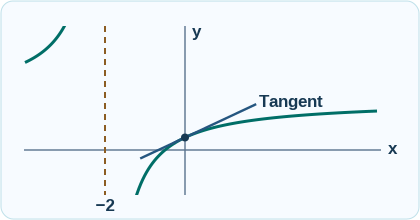
Two branches of the quotient graph are separated by the excluded input x equals negative 2. A tangent rises through the y-intercept.