Maths4U · Learning together
Planes and axes of symmetry (Extended)
Work on paper, compare with the solution or mark scheme, and record your result. Submit solutions and files in your teacher’s assignments.
Search & filters
Available tasks: 20
- 1Exam4 pts
Locate symmetry planes in two prisms
Consider a right triangular prism with its two ends 12 cm apart. How far from one end is the mirror plane which swaps the matching ends?

Show the readings or working used.
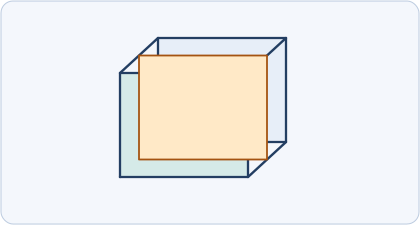
[2]Consider a cuboid with the three different edge lengths 13 cm, 15 cm and 17 cm. How many mirror planes are parallel to its faces?
- 6
- 3
- 2
Show the readings or working used.
[2]
- 2Exam4 pts
Locate symmetry planes in two prisms
Consider a right triangular prism with its two ends 13 cm apart. How far from one end is the mirror plane which swaps the matching ends?
Show the readings or working used.
[2]Consider a cuboid with the three different edge lengths 14 cm, 16 cm and 18 cm. How many mirror planes are parallel to its faces?
- 3
- 2
- 6
Show the readings or working used.
[2]
- 3Exam4 pts
Locate symmetry planes in two prisms
Consider a right triangular prism with its two ends 14 cm apart. How far from one end is the mirror plane which swaps the matching ends?
Show the readings or working used.
[2]Consider a cuboid with the three different edge lengths 15 cm, 17 cm and 19 cm. How many mirror planes are parallel to its faces?
- 2
- 6
- 3
Show the readings or working used.
[2]
- 4Exam4 pts
Locate symmetry planes in two prisms
Consider a right triangular prism with its two ends 15 cm apart. How far from one end is the mirror plane which swaps the matching ends?
Show the readings or working used.
[2]Consider a cuboid with the three different edge lengths 16 cm, 18 cm and 20 cm. How many mirror planes are parallel to its faces?
- 6
- 3
- 2
Show the readings or working used.
[2]
- 5Exam4 pts
Compare planes of a cuboid and cylinder
Consider a cuboid with the three different edge lengths 16 cm, 18 cm and 20 cm. How many mirror planes are parallel to its faces?
- 6
- 3
- 2
Show the readings or working used.
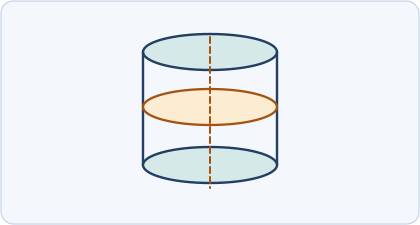
[2]Consider a right circular cylinder of height 17 cm. How far from the base is the mirror plane that swaps the two circular ends?
Show the readings or working used.
[2]
- 6Exam4 pts
Compare planes of a cuboid and cylinder
Consider a cuboid with the three different edge lengths 17 cm, 19 cm and 21 cm. How many mirror planes are parallel to its faces?
- 3
- 2
- 6
Show the readings or working used.
[2]Consider a right circular cylinder of height 18 cm. How far from the base is the mirror plane that swaps the two circular ends?
Show the readings or working used.
[2]
- 7Exam4 pts
Compare planes of a cuboid and cylinder
Consider a cuboid with the three different edge lengths 18 cm, 20 cm and 22 cm. How many mirror planes are parallel to its faces?
- 2
- 6
- 3
Show the readings or working used.
[2]Consider a right circular cylinder of height 19 cm. How far from the base is the mirror plane that swaps the two circular ends?
Show the readings or working used.
[2]
- 8Exam4 pts
Compare planes of a cuboid and cylinder
Consider a cuboid with the three different edge lengths 19 cm, 21 cm and 23 cm. How many mirror planes are parallel to its faces?
- 6
- 3
- 2
Show the readings or working used.
[2]Consider a right circular cylinder of height 20 cm. How far from the base is the mirror plane that swaps the two circular ends?
Show the readings or working used.
[2]
- 9Exam4 pts
Read the plane or axis of a circular solid
Consider a right circular cylinder of height 20 cm. How far from the base is the mirror plane that swaps the two circular ends?
Show the readings or working used.
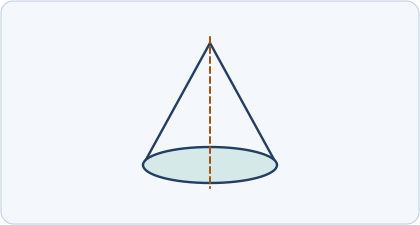
[2]Consider a right circular cone with perpendicular height 21 cm. How long is the portion of its central symmetry axis from the base to the apex?
Show the readings or working used.
[2]
- 10Exam4 pts
Read the plane or axis of a circular solid
Consider a right circular cylinder of height 21 cm. How far from the base is the mirror plane that swaps the two circular ends?
Show the readings or working used.
[2]Consider a right circular cone with perpendicular height 5 cm. How long is the portion of its central symmetry axis from the base to the apex?
Show the readings or working used.
[2]
- 11Exam4 pts
Read the plane or axis of a circular solid
Consider a right circular cylinder of height 5 cm. How far from the base is the mirror plane that swaps the two circular ends?
Show the readings or working used.
[2]Consider a right circular cone with perpendicular height 6 cm. How long is the portion of its central symmetry axis from the base to the apex?
Show the readings or working used.
[2]
- 12Exam4 pts
Read the plane or axis of a circular solid
Consider a right circular cylinder of height 6 cm. How far from the base is the mirror plane that swaps the two circular ends?
Show the readings or working used.
[2]Consider a right circular cone with perpendicular height 7 cm. How long is the portion of its central symmetry axis from the base to the apex?
Show the readings or working used.
[2]
- 13Exam4 pts
Use the axis of a cone and a pyramid
Consider a right circular cone with perpendicular height 7 cm. How long is the portion of its central symmetry axis from the base to the apex?
Show the readings or working used.
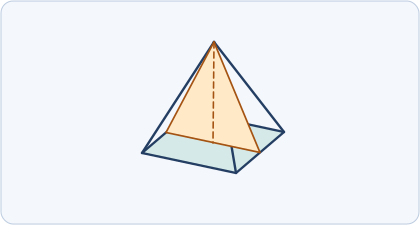
[2]Consider a right square-based pyramid whose square has side 10 cm. A turn of about the line through its apex and base centre returns it to an identical position. What is its complete order of rotation?
- 1
- 4
- 2
Show the readings or working used.
[2]
- 14Exam4 pts
Use the axis of a cone and a pyramid
Consider a right circular cone with perpendicular height 8 cm. How long is the portion of its central symmetry axis from the base to the apex?
Show the readings or working used.
[2]Consider a right square-based pyramid whose square has side 4 cm. A turn of about the line through its apex and base centre returns it to an identical position. What is its complete order of rotation?
- 4
- 2
- 1
Show the readings or working used.
[2]
- 15Exam4 pts
Use the axis of a cone and a pyramid
Consider a right circular cone with perpendicular height 9 cm. How long is the portion of its central symmetry axis from the base to the apex?
Show the readings or working used.
[2]Consider a right square-based pyramid whose square has side 5 cm. A turn of about the line through its apex and base centre returns it to an identical position. What is its complete order of rotation?
- 2
- 1
- 4
Show the readings or working used.
[2]
- 16Exam4 pts
Use the axis of a cone and a pyramid
Consider a right circular cone with perpendicular height 10 cm. How long is the portion of its central symmetry axis from the base to the apex?
Show the readings or working used.
[2]Consider a right square-based pyramid whose square has side 6 cm. A turn of about the line through its apex and base centre returns it to an identical position. What is its complete order of rotation?
- 1
- 4
- 2
Show the readings or working used.
[2]
- 17Exam4 pts
Compare rotating and reflecting solids
Consider a right square-based pyramid whose square has side 6 cm. A turn of about the line through its apex and base centre returns it to an identical position. What is its complete order of rotation?
- 1
- 4
- 2
Show the readings or working used.
[2]Consider a right circular cylinder of radius 12 cm. Does every plane passing through the central lengthways axis reflect the cylinder onto itself?
- Yes
- Only planes parallel to the circular ends
- No, a curved surface rules out mirror symmetry
Show the readings or working used.
[2]
- 18Exam4 pts
Compare rotating and reflecting solids
Consider a right square-based pyramid whose square has side 7 cm. A turn of about the line through its apex and base centre returns it to an identical position. What is its complete order of rotation?
- 4
- 2
- 1
Show the readings or working used.
[2]Consider a right circular cylinder of radius 13 cm. Does every plane passing through the central lengthways axis reflect the cylinder onto itself?
- Only planes parallel to the circular ends
- No, a curved surface rules out mirror symmetry
- Yes
Show the readings or working used.
[2]
- 19Exam4 pts
Compare rotating and reflecting solids
Consider a right square-based pyramid whose square has side 8 cm. A turn of about the line through its apex and base centre returns it to an identical position. What is its complete order of rotation?
- 2
- 1
- 4
Show the readings or working used.
[2]Consider a right circular cylinder of radius 14 cm. Does every plane passing through the central lengthways axis reflect the cylinder onto itself?
- No, a curved surface rules out mirror symmetry
- Yes
- Only planes parallel to the circular ends
Show the readings or working used.
[2]
- 20Exam4 pts
Compare rotating and reflecting solids
Consider a right square-based pyramid whose square has side 9 cm. A turn of about the line through its apex and base centre returns it to an identical position. What is its complete order of rotation?
- 1
- 4
- 2
Show the readings or working used.
[2]Consider a right circular cylinder of radius 15 cm. Does every plane passing through the central lengthways axis reflect the cylinder onto itself?
- Yes
- Only planes parallel to the circular ends
- No, a curved surface rules out mirror symmetry
Show the readings or working used.
[2]