Maths4U · Learning together
Angles in parallel lines
Work on paper, compare with the solution or mark scheme, and record your result. Submit solutions and files in your teacher’s assignments.
Search & filters
Available tasks: 20
- 1Exam4 pts
Read corresponding and alternate pairs
The two horizontal lines are parallel. Find x and use the marked angles.
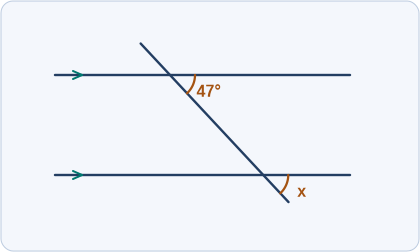
Show the readings or working used.
[2]The two horizontal lines are parallel. Find x and use the marked angles.
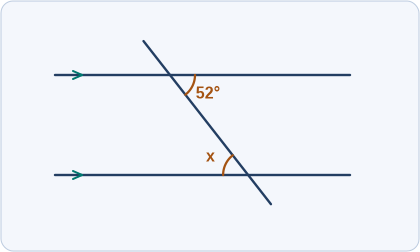
Show the readings or working used.
[2]
- 2Exam4 pts
Read corresponding and alternate pairs
The two horizontal lines are parallel. Find x and use the marked angles.
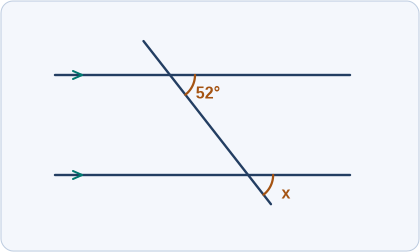
Show the readings or working used.
[2]The two horizontal lines are parallel. Find x and use the marked angles.
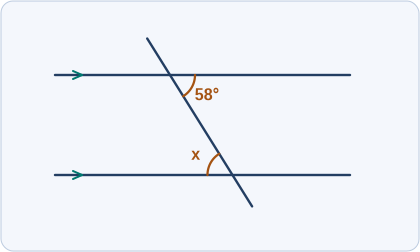
Show the readings or working used.
[2]
- 3Exam4 pts
Read corresponding and alternate pairs
The two horizontal lines are parallel. Find x and use the marked angles.
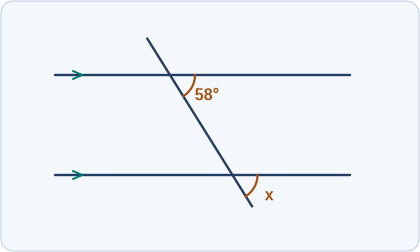
Show the readings or working used.
[2]The two horizontal lines are parallel. Find x and use the marked angles.
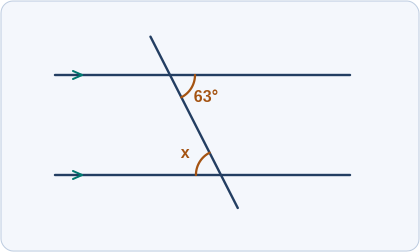
Show the readings or working used.
[2]
- 4Exam4 pts
Read corresponding and alternate pairs
The two horizontal lines are parallel. Find x and use the marked angles.
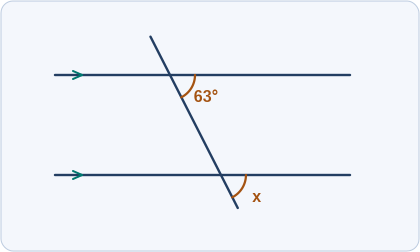
Show the readings or working used.
[2]The two horizontal lines are parallel. Find x and use the marked angles.
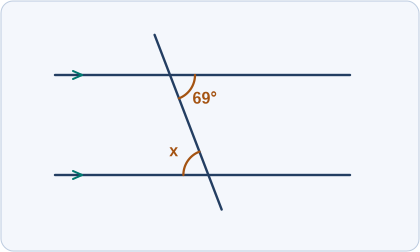
Show the readings or working used.
[2]
- 5Exam4 pts
Compare alternate and co-interior pairs
The two horizontal lines are parallel. Find x and use the marked angles.
Show the readings or working used.
[2]The two horizontal lines are parallel. Find x and use the marked angles.
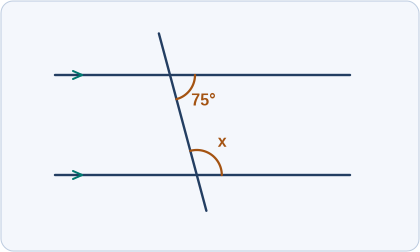
Show the readings or working used.
[2]
- 6Exam4 pts
Compare alternate and co-interior pairs
The two horizontal lines are parallel. Find x and use the marked angles.
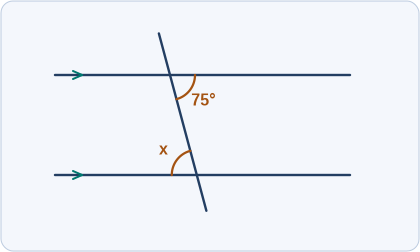
Show the readings or working used.
[2]The two horizontal lines are parallel. Find x and use the marked angles.
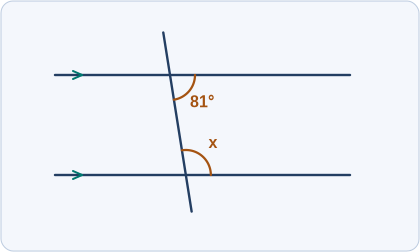
Show the readings or working used.
[2]
- 7Exam4 pts
Compare alternate and co-interior pairs
The two horizontal lines are parallel. Find x and use the marked angles.
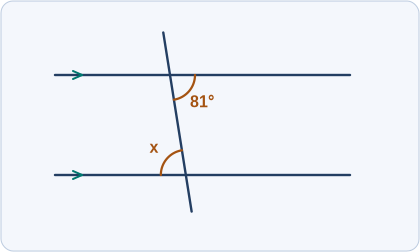
Show the readings or working used.
[2]The two horizontal lines are parallel. Find x and use the marked angles.
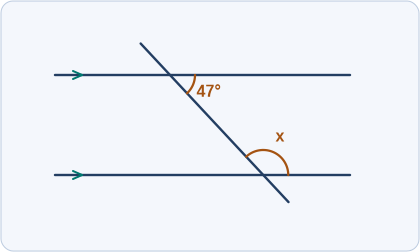
Show the readings or working used.
[2]
- 8Exam4 pts
Compare alternate and co-interior pairs
The two horizontal lines are parallel. Find x and use the marked angles.
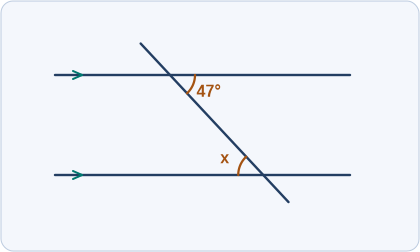
Show the readings or working used.
[2]The two horizontal lines are parallel. Find x and use the marked angles.
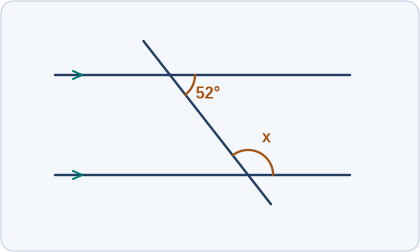
Show the readings or working used.
[2]
- 9Exam4 pts
Use a supplementary pair and form an equation
The two horizontal lines are parallel. Find x and use the marked angles.
Show the readings or working used.
[2]Two corresponding angles on parallel lines are and . Find x.
Show the readings or working used.
[2]
- 10Exam4 pts
Use a supplementary pair and form an equation
The two horizontal lines are parallel. Find x and use the marked angles.
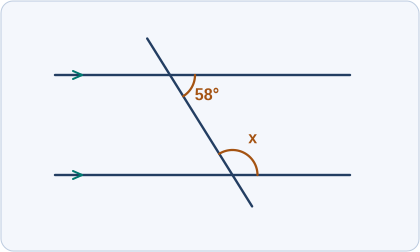
Show the readings or working used.
[2]Two corresponding angles on parallel lines are and . Find x.
Show the readings or working used.
[2]
- 11Exam4 pts
Use a supplementary pair and form an equation
The two horizontal lines are parallel. Find x and use the marked angles.
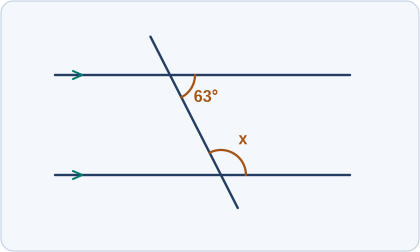
Show the readings or working used.
[2]Two corresponding angles on parallel lines are and . Find x.
Show the readings or working used.
[2]
- 12Exam4 pts
Use a supplementary pair and form an equation
The two horizontal lines are parallel. Find x and use the marked angles.
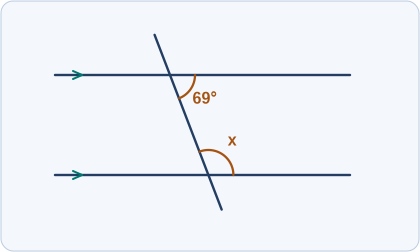
Show the readings or working used.
[2]Two corresponding angles on parallel lines are and . Find x.
Show the readings or working used.
[2]
- 13Exam4 pts
Explain when equal-angle rules apply
Two corresponding angles on parallel lines are and . Find x.
Show the readings or working used.
[2]Two straight lines are crossed by a transversal. One angle is . The two lines are not known to be parallel. Can you conclude its corresponding angle is the same?
- Yes, angles are always equal if they lie on two lines
- No, the lines must be established as parallel
- Yes, every corresponding pair is equal
Show the readings or working used.
[2]
- 14Exam4 pts
Explain when equal-angle rules apply
Two corresponding angles on parallel lines are and . Find x.
Show the readings or working used.
[2]Two straight lines are crossed by a transversal. One angle is . The two lines are not known to be parallel. Can you conclude its corresponding angle is the same?
- No, the lines must be established as parallel
- Yes, every corresponding pair is equal
- Yes, angles are always equal if they lie on two lines
Show the readings or working used.
[2]
- 15Exam4 pts
Explain when equal-angle rules apply
Two corresponding angles on parallel lines are and . Find x.
Show the readings or working used.
[2]Two straight lines are crossed by a transversal. One angle is . The two lines are not known to be parallel. Can you conclude its corresponding angle is the same?
- Yes, every corresponding pair is equal
- Yes, angles are always equal if they lie on two lines
- No, the lines must be established as parallel
Show the readings or working used.
[2]
- 16Exam4 pts
Explain when equal-angle rules apply
Two corresponding angles on parallel lines are and . Find x.
Show the readings or working used.
[2]Two straight lines are crossed by a transversal. One angle is . The two lines are not known to be parallel. Can you conclude its corresponding angle is the same?
- Yes, angles are always equal if they lie on two lines
- No, the lines must be established as parallel
- Yes, every corresponding pair is equal
Show the readings or working used.
[2]
- 17Exam4 pts
Combine an alternate angle and a straight-line sum
Two straight lines are crossed by a transversal. One angle is . The two lines are not known to be parallel. Can you conclude its corresponding angle is the same?
- Yes, angles are always equal if they lie on two lines
- No, the lines must be established as parallel
- Yes, every corresponding pair is equal
Show the readings or working used.
[2]Two parallel lines meet a transversal. One angle is . Its alternate angle and x are next to each other on a straight line. Find x.
Show the readings or working used.
[2]
- 18Exam4 pts
Combine an alternate angle and a straight-line sum
Two straight lines are crossed by a transversal. One angle is . The two lines are not known to be parallel. Can you conclude its corresponding angle is the same?
- No, the lines must be established as parallel
- Yes, every corresponding pair is equal
- Yes, angles are always equal if they lie on two lines
Show the readings or working used.
[2]Two parallel lines meet a transversal. One angle is . Its alternate angle and x are next to each other on a straight line. Find x.
Show the readings or working used.
[2]
- 19Exam4 pts
Combine an alternate angle and a straight-line sum
Two straight lines are crossed by a transversal. One angle is . The two lines are not known to be parallel. Can you conclude its corresponding angle is the same?
- Yes, every corresponding pair is equal
- Yes, angles are always equal if they lie on two lines
- No, the lines must be established as parallel
Show the readings or working used.
[2]Two parallel lines meet a transversal. One angle is . Its alternate angle and x are next to each other on a straight line. Find x.
Show the readings or working used.
[2]
- 20Exam4 pts
Combine an alternate angle and a straight-line sum
Two straight lines are crossed by a transversal. One angle is . The two lines are not known to be parallel. Can you conclude its corresponding angle is the same?
- Yes, angles are always equal if they lie on two lines
- No, the lines must be established as parallel
- Yes, every corresponding pair is equal
Show the readings or working used.
[2]Two parallel lines meet a transversal. One angle is . Its alternate angle and x are next to each other on a straight line. Find x.
Show the readings or working used.
[2]