Maths4U · Learning together
Measure and construct with ruler and compasses
Work on paper, compare with the solution or mark scheme, and record your result. Submit solutions and files in your teacher’s assignments.
Search & filters
Available tasks: 20
- 1Exam4 pts
Measure and draw an angle
Measure the marked smaller angle to the nearest degree. Treat the horizontal ray to the right as the starting ray.
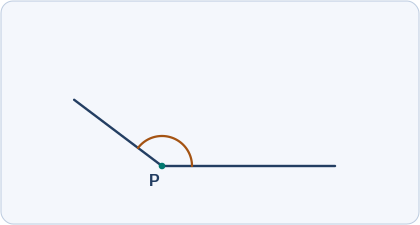
Show the readings or working used.
[2]Using the baseline, draw an angle of at P.
[2]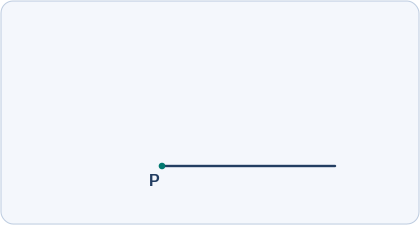
- 2Exam4 pts
Measure and draw an angle
Measure the marked smaller angle to the nearest degree. Treat the horizontal ray to the right as the starting ray.
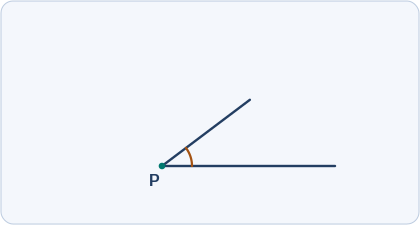
Show the readings or working used.
[2]Using the baseline, draw an angle of at P.
[2]
- 3Exam4 pts
Measure and draw an angle
Measure the marked smaller angle to the nearest degree. Treat the horizontal ray to the right as the starting ray.
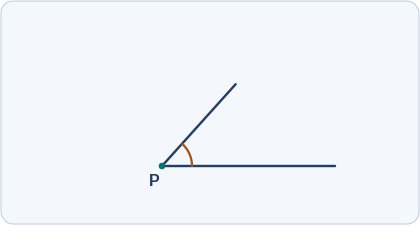
Show the readings or working used.
[2]Using the baseline, draw an angle of at P.
[2]
- 4Exam4 pts
Measure and draw an angle
Measure the marked smaller angle to the nearest degree. Treat the horizontal ray to the right as the starting ray.
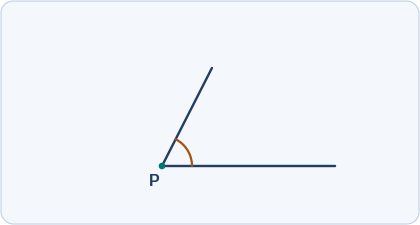
Show the readings or working used.
[2]Using the baseline, draw an angle of at P.
[2]
- 5Exam4 pts
Draw an angle and use a reference bar
Using the baseline, draw an angle of at P.
[2]The reference bar represents 1 cm. Read the length of AB without relying on the size displayed on your screen.
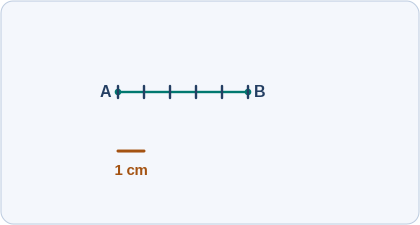
Show the readings or working used.
[2]
- 6Exam4 pts
Draw an angle and use a reference bar
Using the baseline, draw an angle of at P.
[2]The reference bar represents 1 cm. Read the length of AB without relying on the size displayed on your screen.
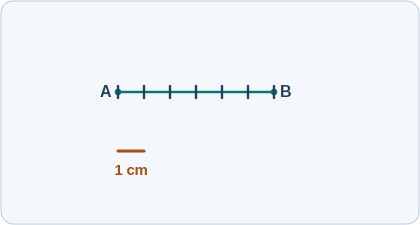
Show the readings or working used.
[2]
- 7Exam4 pts
Draw an angle and use a reference bar
Using the baseline, draw an angle of at P.
[2]The reference bar represents 1 cm. Read the length of AB without relying on the size displayed on your screen.
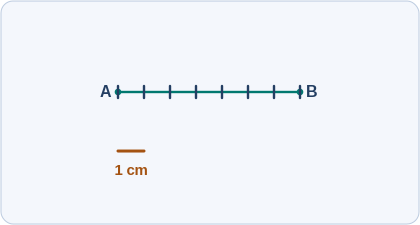
Show the readings or working used.
[2]
- 8Exam4 pts
Draw an angle and use a reference bar
Using the baseline, draw an angle of at P.
[2]The reference bar represents 1 cm. Read the length of AB without relying on the size displayed on your screen.
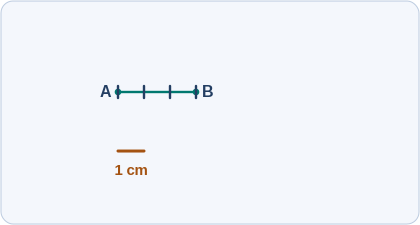
Show the readings or working used.
[2]
- 9Exam5 pts
Measure lengths and set the compasses
The reference bar represents 1 cm. Read the length of AB without relying on the size displayed on your screen.
Show the readings or working used.
[2]Use a ruler and pair of compasses to construct triangle ABC with AB = 6 cm, AC = 4 cm and BC = 7 cm. Keep both arcs.
[3]
- 10Exam5 pts
Measure lengths and set the compasses
The reference bar represents 1 cm. Read the length of AB without relying on the size displayed on your screen.
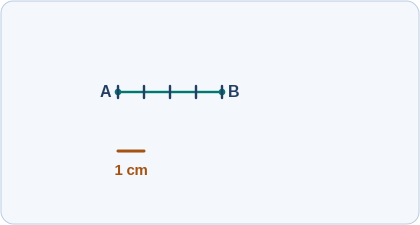
Show the readings or working used.
[2]Use a ruler and pair of compasses to construct triangle ABC with AB = 7 cm, AC = 6 cm and BC = 8 cm. Keep both arcs.
[3]
- 11Exam5 pts
Measure lengths and set the compasses
The reference bar represents 1 cm. Read the length of AB without relying on the size displayed on your screen.
Show the readings or working used.
[2]Use a ruler and pair of compasses to construct triangle ABC with AB = 5 cm, AC = 4 cm and BC = 6 cm. Keep both arcs.
[3]
- 12Exam5 pts
Measure lengths and set the compasses
The reference bar represents 1 cm. Read the length of AB without relying on the size displayed on your screen.
Show the readings or working used.
[2]Use a ruler and pair of compasses to construct triangle ABC with AB = 6 cm, AC = 5 cm and BC = 7 cm. Keep both arcs.
[3]
- 13Exam6 pts
Construct a triangle from all three sides
Use a ruler and pair of compasses to construct triangle ABC with AB = 6 cm, AC = 5 cm and BC = 7 cm. Keep both arcs.
[3]Use a ruler and pair of compasses to construct triangle ABC with AB = 7 cm, AC = 5 cm and BC = 6 cm. Keep both arcs.
[3]
- 14Exam6 pts
Construct a triangle from all three sides
Use a ruler and pair of compasses to construct triangle ABC with AB = 7 cm, AC = 5 cm and BC = 6 cm. Keep both arcs.
[3]Use a ruler and pair of compasses to construct triangle ABC with AB = 8 cm, AC = 5 cm and BC = 7 cm. Keep both arcs.
[3]
- 15Exam6 pts
Construct a triangle from all three sides
Use a ruler and pair of compasses to construct triangle ABC with AB = 8 cm, AC = 5 cm and BC = 7 cm. Keep both arcs.
[3]Use a ruler and pair of compasses to construct triangle ABC with AB = 6 cm, AC = 4 cm and BC = 7 cm. Keep both arcs.
[3]
- 16Exam6 pts
Construct a triangle from all three sides
Use a ruler and pair of compasses to construct triangle ABC with AB = 6 cm, AC = 4 cm and BC = 7 cm. Keep both arcs.
[3]Use a ruler and pair of compasses to construct triangle ABC with AB = 7 cm, AC = 6 cm and BC = 8 cm. Keep both arcs.
[3]
- 17Exam6 pts
Construct a triangle and a rhombus
Use a ruler and pair of compasses to construct triangle ABC with AB = 7 cm, AC = 6 cm and BC = 8 cm. Keep both arcs.
[3]Construct a rhombus with sides and one diagonal . Leave your compass arcs visible.
[3]
- 18Exam6 pts
Construct a triangle and a rhombus
Use a ruler and pair of compasses to construct triangle ABC with AB = 5 cm, AC = 4 cm and BC = 6 cm. Keep both arcs.
[3]Construct a rhombus with sides and one diagonal . Leave your compass arcs visible.
[3]
- 19Exam6 pts
Construct a triangle and a rhombus
Use a ruler and pair of compasses to construct triangle ABC with AB = 6 cm, AC = 5 cm and BC = 7 cm. Keep both arcs.
[3]Construct a rhombus with sides and one diagonal . Leave your compass arcs visible.
[3]
- 20Exam6 pts
Construct a triangle and a rhombus
Use a ruler and pair of compasses to construct triangle ABC with AB = 7 cm, AC = 5 cm and BC = 6 cm. Keep both arcs.
[3]Construct a rhombus with sides and one diagonal . Leave your compass arcs visible.
[3]