Cambridge IGCSE Mathematics (0580) · Differentiation · Quick revision
Estimate the gradient of a curve
How do I place a ruler to draw the tangent?
The tangent is a straight line through the point that matches the local direction of the curve. Look just to the left and right of the point when lining up the ruler.
Mark the point first. Follow the curve for a short distance near it and adjust the ruler until the line has the same direction there. Draw that line long enough to read two separated points.
Which two points should I use?
Use points on the line you drew. Pick easy-to-read points well apart, preferably at grid intersections. A shallow line might need quite a long run.
Find . Keep the order of subtraction the same above and below the fraction bar. Count actual axis units rather than squares when the scales differ.
Why is my answer an estimate?
A line drawn by eye and coordinates read from a grid have limited precision. Your estimate should have the right sign and be supported by the line and the points you used.
Draw the tangent with a ruler, give the two coordinates and show the gradient calculation. A falling tangent must give a negative gradient when read from left to right.
Quick worked example
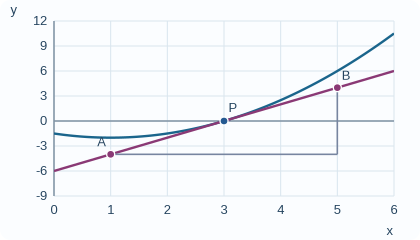
Two measured points on a tangent at are and . Calculate the gradient of the marked tangent.
Go from A to B. The signed change in height is and the change in x is .
Divide the change in height by the change in x. The gradient is .