Cambridge IGCSE Mathematics (0580) · Algebraic fractions · Quick revision
Multiply and divide algebraic fractions
What do I multiply first?
Multiply the top expressions to make one numerator. Multiply the bottom expressions to make one denominator.
Cancel any factor that is common to the whole new numerator and denominator. You can also cancel that factor before multiplying when you can see it clearly.
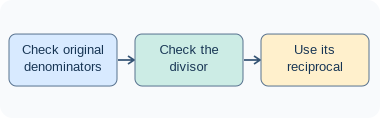
Which fraction do I turn over?
The second fraction is the amount you divide by. The reciprocal interchanges its top and bottom.
Keep the first fraction and change division into multiplication by the second fraction's reciprocal. For instance, .
Which values must be excluded before dividing?
The two fractions must both be defined. The second fraction must also be non-zero because it is the divisor.
Find zeros of both original denominators. Also find the zeros of the divisor's numerator. With as a divisor, exclude and .
Quick worked example
Simplify fully.
Put above . The original denominator was non-zero, so .
Cancel one factor of x and reduce the numerical factors of the top and bottom.
The simplified result is .
The original restrictions remain .